
Best Momentic alternatives in 2026: 7 tools compared
By qtrl Team · Engineering
Momentic earned its early spot on QA shortlists by being clean, natural-language first, and visibly modern at a time when the category still ran on record-and-replay. Two years later the bar has moved: agentic execution, unified management plus AI, and device-cloud vendors shipping their own AI layers all crowd the same space. The seven options below cover the credible 2026 shortlist for teams reevaluating. Vendor disclosure: qtrl is on the list.
TL;DR: the seven Momentic alternatives that actually compete
For agentic execution paired with structured test management, qtrl. For BrowserStack customers wanting AI execution on top of their device cloud, Kane AI. For managed functional E2E with auto-healing maintenance, Mabl. For natural-language authoring on a managed platform, Functionize. For ML-assisted locator stability and record-and-tweak workflows, Testim. For enterprise model-based testing with AI authoring, Tricentis Tosca with Copilot. For visual AI on top of any framework, Applitools. Pricing is per vendor and per tier; pull current numbers from each sales team.
What Momentic does well, and why teams still look elsewhere
Momentic's strengths are real: natural-language test authoring with AI-driven element identification, a clean modern UI, fast setup, and a model that doesn't require building a Playwright or Cypress framework first. For teams whose primary pain was "every script breaks on a class rename," Momentic was a meaningful step forward.
Three patterns push teams to evaluate alternatives. First, the execution-only gap: Momentic runs tests but doesn't hold the cases, runs, and audit trail in a structured management layer, so teams end up stitching it to TestRail, Jira, or a spreadsheet. Second, agent depth: the gap between "natural-language authoring" and "agent that recovers from real UI drift" has widened, and AI-native execution tools that learn an app's patterns across runs produce a different reliability profile. Third, pricing realism: usage-based costs scale fast once a team starts running real regression volume.
What to look for in a Momentic alternative
Nine criteria that decide a real evaluation:
- Agent resilience under UI drift. Most tools pass the demo. The ones that survive a real product's weekly UI churn are a smaller list. Test on two weeks of normal release cadence.
- Adaptive memory across runs. Does the agent learn your app's patterns and reuse them, or does each run start cold? This changes the cost curve at scale.
- Structured test management. Versioned cases, review workflows, immutable run history. A runner without management means you'll buy a second tool soon.
- Manual + AI in one run. A tester and an agent contributing to the same run, with unified reporting, beats stitching two histories.
- Natural-language authoring quality. Specifically, on your real PRDs, not vendor demos. Most tools produce something; few produce cases you don't edit heavily.
- CI integration depth. Real hooks for GitHub Actions, GitLab CI, Jenkins, CircleCI, Bitbucket Pipelines, Azure DevOps. Not generic webhooks.
- Pricing realism under regression volume. Per-run-minute or per-flow pricing climbs fast. Validate the numbers on real CI peaks before signing.
- Audit and compliance shape. The EU AI Act and the NIST AI Risk Management Framework expect immutable evidence shapes that scripted-only tools struggle to produce.
- Device and browser coverage. If you're also dependent on a device cloud, the integration with BrowserStack, Sauce Labs, or LambdaTest matters. See best BrowserStack alternatives for the device cloud picture.
Momentic alternatives compared at a glance
| Tool | Best for | Agent browser execution | Natural language authoring | Adaptive memory |
|---|---|---|---|---|
| qtrl | Execution + management together | ✓ | ✓ | ✓ |
| BrowserStack Kane AI | BrowserStack customers | ✓ | ✓ | ✗ |
| Mabl | Managed E2E + auto-healing | ! scripted runs | ! limited | ! flake clustering |
| Functionize | NL authoring + managed | ! scripted runs | ✓ | ! ML-assisted |
| Testim | Selector-flake stability | ✗ | ! limited | ! ML locators |
| Tricentis Tosca + Copilot | Enterprise model-based | ! within Tosca | ✓ | ✗ |
| Applitools (Eyes + Autonomous) | Visual specialist | ! visual focus | ✗ | ! visual baselines |
1. qtrl: agentic execution plus structured management
qtrl is the broadest alternative to Momentic in scope. Natural-language authoring and AI execution, but also a structured test management system holding the cases, runs, manual execution, and audit trail. Adaptive memory means the agent learns the patterns of your app across runs rather than treating each one as the first.
Key features:
- Agentic browser execution with progressive autonomy (you set the level of agent initiative per flow).
- Natural language authoring from PRDs, user stories, design specs, and exploratory sessions.
- Adaptive memory: agents learn your app's patterns across runs.
- Versioned test cases with branchable history and review-gated changes.
- Manual and AI execution in the same run, with one unified history.
- Immutable audit trail produced as a side-effect of normal work.
- Two-way Jira integration (issue links, status updates, defect creation).
- CI hooks for GitHub Actions, GitLab CI, Jenkins, CircleCI, Bitbucket Pipelines, Azure DevOps.
Where it wins vs. Momentic:
- Test management is built in, not a separate purchase.
- Manual + AI runs share one history.
- Adaptive memory makes the second run faster than the first; Momentic restarts each run colder.
- Audit shape fits EU AI Act and NIST AI RMF without bolt-on integrations.
- Progressive autonomy lets you keep human oversight where it matters.
Where another tool fits better:
- If you only want a clean authoring layer for a small flow set and Momentic's scope already fits, the simpler tool is the simpler tool.
- If your testing is dominated by visual regression, a specialist like Applitools earns its slot.
- If you're already deep into BrowserStack's device cloud, Kane AI is the cleaner bundle.
Best for: teams that want AI execution plus a real test management layer in one system, with audit and governance built for regulated work.
Choose this if you want AI execution plus a real test management layer, not a runner you have to wire into a separate management system.
2. BrowserStack Kane AI: the device-cloud bundle
Kane AI is BrowserStack's agentic testing product. Natural-language test specs, real browsers on the BrowserStack cloud, integrated with their device farm. If your team is already paying for BrowserStack capacity, Kane AI is the natural add-on without procuring a new vendor.
Key features:
- Natural-language test authoring tied to BrowserStack runs.
- Agentic execution against real browsers and real devices.
- Bundled with existing BrowserStack contracts.
- Integrations with the BrowserStack reporting and observability stack.
- Mobile and desktop coverage through the existing device cloud.
- CI integration with the standard major providers.
Where it wins:
- Procurement is already done if you're a BrowserStack customer.
- Device cloud access is bundled.
- Reporting lives inside BrowserStack Test Observability.
- Mobile coverage is genuinely strong.
Where it falls short:
- No standalone management layer; you still need TestRail, Jira, or qtrl alongside.
- Lock-in to BrowserStack's pricing model.
- Audit shape is built for cloud test runs, not regulated AI testing.
- If you're leaving BrowserStack already, this is the wrong direction.
Best for: BrowserStack customers wanting agentic execution on top of their existing capacity contract.
Choose this if you're already a BrowserStack customer and want agentic execution on top of that footprint.
3. Mabl: managed E2E with ML-assisted maintenance
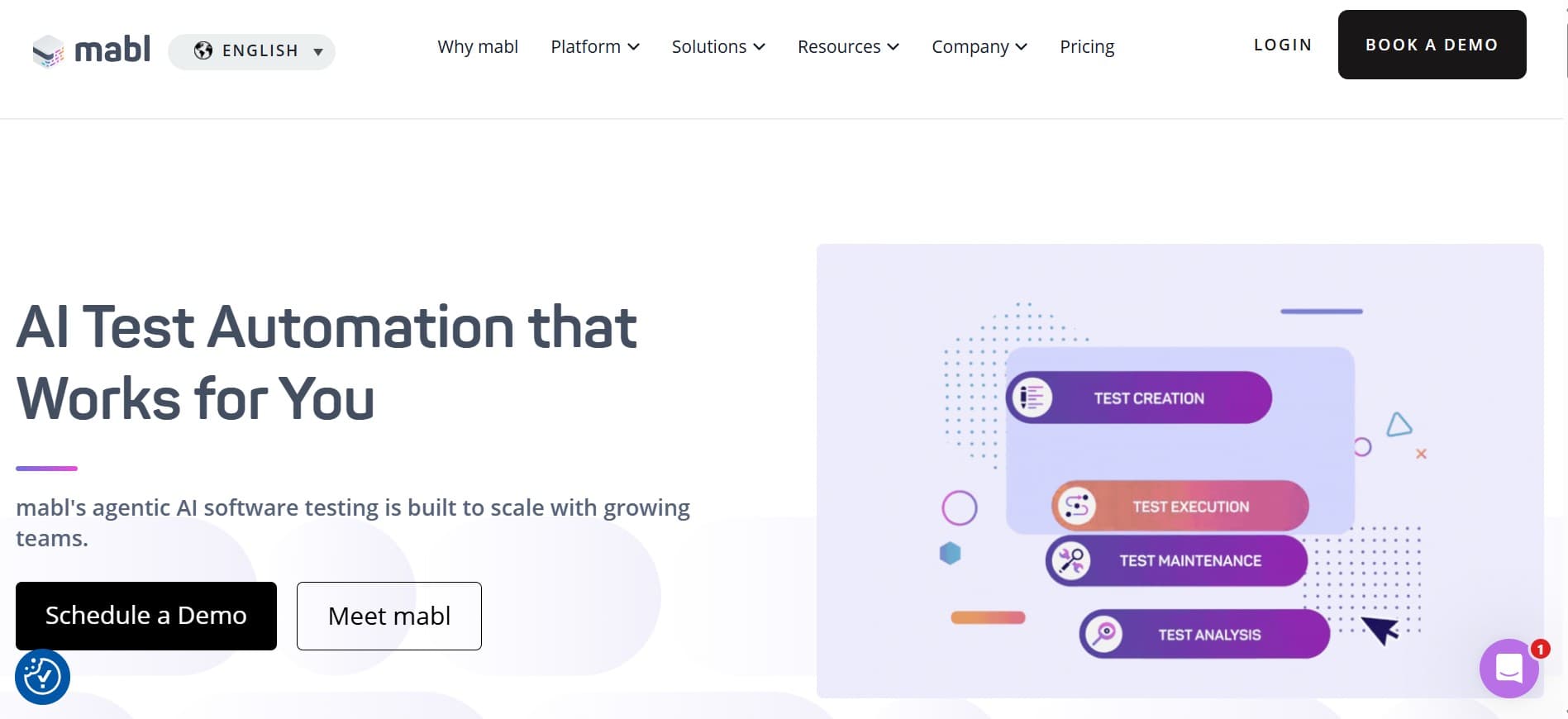
Mabl has been doing ML-assisted functional E2E for years. Auto-healing selectors, integrated reporting, a stable platform. Execution is scripted, not autonomous, so the AI is mostly maintenance and analytics rather than agentic capability.
Key features:
- Low-code authoring with ML-assisted element identification.
- Auto-healing tests that adapt to small UI changes.
- Managed cloud execution across browsers.
- API testing and accessibility testing add-ons.
- Native CI integration (GitHub Actions, GitLab CI, Jenkins, CircleCI).
- Test analytics and flake dashboards.
Where it wins:
- Auto-healing genuinely cuts flake on small UI changes.
- Low-code authoring lowers the barrier for non-engineers.
- Managed execution removes infrastructure work.
- Strong analytics for triaging flaky suites.
Where it falls short:
- Execution is scripted, not autonomous; the AI is maintenance, not an agent.
- Low-code abstraction can hit a ceiling on complex flows.
- No real-device cloud; mobile coverage is shallow.
- Pricing climbs at scale.
Best for: teams that want managed E2E with smart maintenance and don't need agentic execution.
Choose this if you want a managed functional E2E platform with smart maintenance and you don't need an autonomous agent.
4. Functionize: NL authoring on a managed platform
Functionize was an early entrant in natural-language authoring backed by ML execution. A managed platform model for teams that don't want to maintain their own framework. The pitch is "describe the test, let us run it" without scripting.
Key features:
- Natural-language test authoring with ML execution.
- Managed cloud platform with no framework to maintain.
- Self-healing tests against UI changes.
- Visual testing and data-driven testing.
- Integrations with major CI providers.
- Enterprise-tier support and onboarding.
Where it wins:
- NL authoring is a first-class capability, not an add-on.
- Managed platform means no Playwright/Cypress framework to maintain.
- Self-healing reduces maintenance overhead.
- Enterprise onboarding is mature.
Where it falls short:
- Execution is scripted under the hood, not agentic.
- Opinionated platform model can resist non-standard flows.
- No structured management layer; pair with another tool.
- Pricing is enterprise-tier from the start.
Best for: teams wanting managed E2E with natural-language authoring and no framework to maintain.
Choose this if you want managed E2E with natural-language authoring and you're comfortable with the platform's opinionated approach.
5. Testim: ML-assisted locator stability
Testim (Tricentis) leans on ML for locator stability rather than agentic execution. Record-and-tweak authoring, CI integrations, smart locators that survive class renames. If your primary pain is selector flake, Testim solves that directly without changing the fundamental authoring model.
Key features:
- ML-assisted locator strategies that survive minor UI changes.
- Record-and-tweak authoring with code export for advanced users.
- Mobile and web execution.
- Integrations with major CI providers and Jira.
- Test pull requests and branching workflows.
- Part of the broader Tricentis stack (qTest, Tosca).
Where it wins:
- Selector stability is genuinely strong.
- Record-and-tweak fits teams that already work that way.
- Tricentis ecosystem integration if you're already on qTest or Tosca.
- Mature enterprise support.
Where it falls short:
- Not agentic; the AI is locator stability, not an autonomous executor.
- NL authoring is limited.
- Record-and-tweak is dated for AI-native teams.
- Pricing is mid- to high-tier.
Best for: teams whose core pain is selector flake on scripted tests rather than a need for agentic execution.
Choose this if selector flake is the core problem and you want ML-assisted locator stability.
6. Tricentis Tosca with Copilot: enterprise model-based + AI authoring
Tosca is the enterprise model-based testing incumbent, with Copilot bringing AI authoring into the existing workflow. Strong on traceability and compliance. Heavy to adopt if you're not already in the Tricentis ecosystem, but well-fitted for large regulated programs that need both AI assistance and audit depth.
Key features:
- Model-based test authoring with deep enterprise compliance primitives.
- Copilot for AI-assisted case generation within Tosca's workflow.
- SAP, Salesforce, ServiceNow, and broad packaged-app integration.
- Mobile, API, and web execution.
- Tight integration with qTest and the rest of the Tricentis stack.
- Mature enterprise governance and audit posture.
Where it wins:
- Compliance and audit depth for regulated industries.
- Packaged-app integration (SAP, Salesforce) that nobody else matches.
- AI Copilot fits into an existing enterprise workflow.
- Tricentis stack integration if you're already on it.
Where it falls short:
- Heavyweight; wrong fit for growth-stage QA orgs.
- AI is bolted on rather than woven through.
- Implementation effort is real.
- Locked into Tricentis pricing and procurement.
Best for: large enterprises already on Tosca who want AI assistance in their existing workflow.
Choose this if you're already on Tosca and want AI assistance without changing the workflow.
7. Applitools (Eyes + Autonomous): the visual specialist
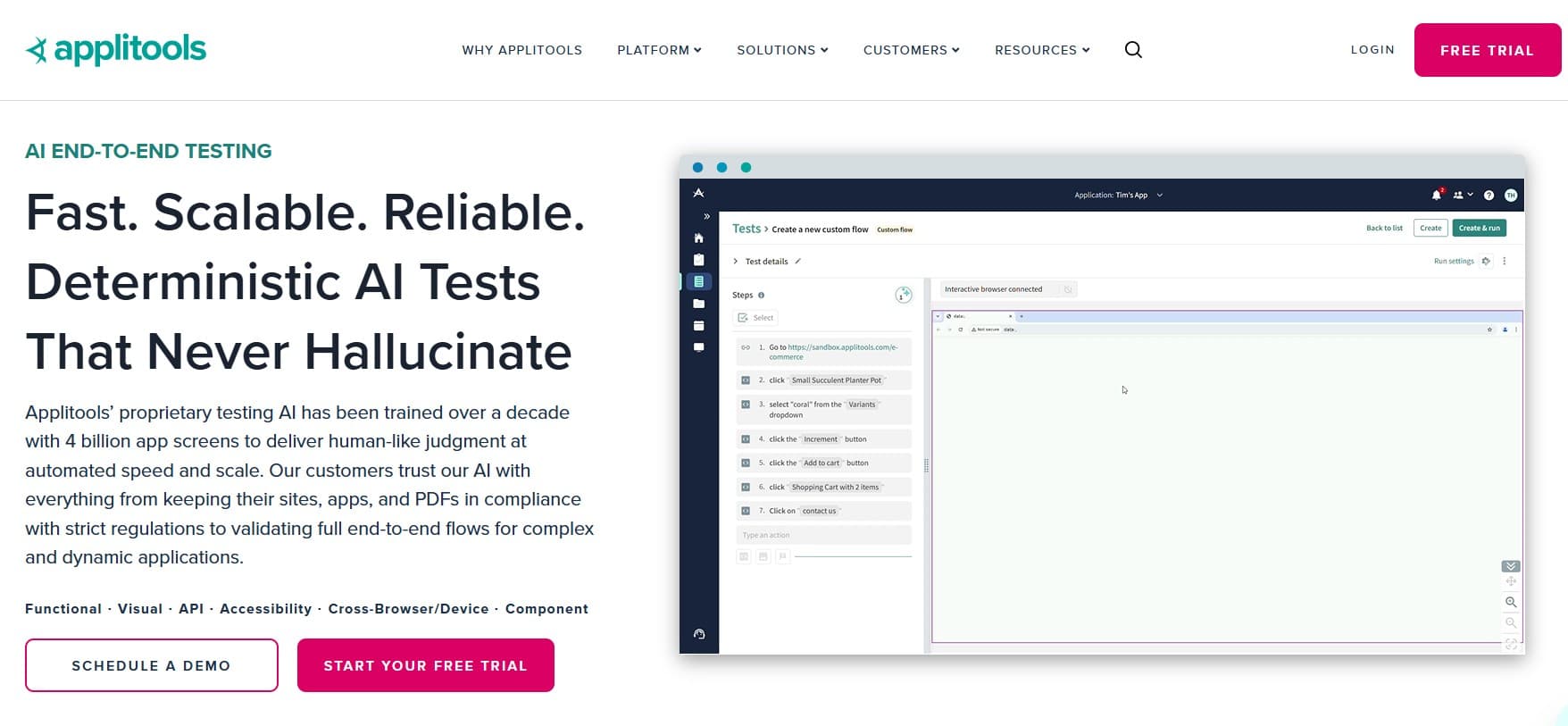
Applitools is the standard for visual testing. Eyes uses ML to compare what the user sees rather than diffing pixels. The Autonomous product extends that toward functional flows. If visual correctness is a big part of your surface, the toolkit is strong.
Key features:
- Visual AI for cross-browser, cross-viewport visual regression.
- Ultrafast Grid for rapid visual checks across many combinations.
- Autonomous product for functional flow testing.
- Integrations with Selenium, Playwright, Cypress, WebDriverIO, Appium.
- Component-level visual testing for design systems.
- Root cause analysis for visual diffs.
Where it wins:
- Visual coverage at a depth nothing else matches.
- Ultrafast Grid replaces a lot of device-cloud cost for visual concerns.
- Mature framework support across the major automation tools.
- Component-level visual checks fit modern design systems.
Where it falls short:
- Primarily a verification layer, not an executor or a manager.
- Pair with functional testing + management for the full stack.
- Pricing climbs with checkpoint volume.
- Autonomous functional capability is newer and less proven than Eyes.
Best for: teams where visual correctness is the primary part of the testing surface.
Choose this if visual correctness is a major part of your product and you want best-in-class visual AI.
Tool comparison summary
| Tool | Strengths | Limitations | Best for |
|---|---|---|---|
| qtrl | Agentic execution + management + audit in one platform | Newer entrant; not a device cloud | Execution + management together |
| BrowserStack Kane AI | Bundled with device cloud, mature cloud reporting | No standalone management; BrowserStack lock-in | BrowserStack customers |
| Mabl | Auto-healing, low-code authoring, managed execution | Scripted, not agentic; low-code ceiling | Managed E2E with smart maintenance |
| Functionize | NL authoring as first-class, managed platform | Scripted execution; no management; enterprise pricing | NL authoring without framework work |
| Testim | ML locator stability, mature enterprise support | Not agentic; dated authoring model | Selector flake as the core pain |
| Tricentis Tosca + Copilot | Compliance depth, packaged-app integration, AI authoring | Heavyweight; AI is a bolt-on; high implementation cost | Enterprises already on Tosca |
| Applitools | Visual AI depth, broad framework support | Verification layer; pair with functional + management | Visual correctness as the primary surface |
How to evaluate without burning a quarter
Most Momentic-replacement evaluations stall on the same patterns. A pragmatic playbook:
- Run two weeks of real release cadence. Demos pass; failure modes show up in week two when the UI has drifted twice and the agent has to recover.
- Pick a real flow that breaks today. Hand the candidate a flow that currently flakes on your scripted tests. That's the real test.
- Validate pricing on real regression volume. Per-flow or per-minute pricing climbs fast. Calculate against your actual regression cadence, not the vendor's demo number.
- Bring management into the trial. If the tool is execution-only, decide upfront whether you'll pair it with TestRail, Jira, or qtrl, and wire that during the trial.
- Test adaptive memory across runs. Does the agent get faster and more reliable on a flow it's seen before? If not, the long-run economics will hurt.
- Plan the cutover. Decide which team or surface moves first, freeze Momentic as read-only on that scope, and commit. Running both indefinitely is how migrations stall.
How to read the agentic-testing market in 2026
Three trajectories matter when comparing Momentic to anything else. First, the gap between "AI authoring" tools and "AI execution" tools is closing fast, so a vendor that does only one is harder to justify. Second, regulated work is pulling audit primitives into the core (driven partly by the EU AI Act), which favors vendors with management depth. Third, device-cloud incumbents are bundling AI into existing contracts, which makes standalone agentic tools compete on capability instead of cost-to-adopt. The shortlist that wins your evaluation should account for all three.
Where qtrl fits in a post-Momentic stack
The most common reason teams move off Momentic isn't the execution side; it's the "and now what" problem. AI runs are useful, but if they don't live inside a test management system with versioning, review, and audit, you end up rebuilding management around them. qtrl was designed for that whole loop, with progressive autonomy (you set how much initiative the agent takes) and adaptive memory under the same management layer. For deeper context see what is agentic testing and AI in software testing: hype vs reality in 2026. The NIST AI Risk Management Framework is the cleanest non-vendor reference for what evidence shape AI testing needs to produce in 2026.
Frequently asked questions about Momentic alternatives
What is the best Momentic alternative in 2026? Depends on what you're solving. qtrl is the closest broad alternative if you want execution plus management. Kane AI if you're on BrowserStack. Mabl or Functionize for managed scripted E2E. Testim if selector flake is the issue. Applitools if visual is the primary surface.
Is agentic browser testing reliable enough for regression? For some flows yes, especially those that change often and break scripted tests constantly. For stable, high-frequency regression, scripted tests are still usually faster and cheaper. Most teams end up with both.
How do AI testing tools handle non-deterministic systems? With the right scaffolding (statistical pass criteria, multiple runs, intent-based oracles) it's feasible. See testing non-deterministic AI systems under the EU AI Act.
What is adaptive memory in an AI testing tool? It's the difference between an agent that starts each run cold and one that remembers your app's patterns across runs. Adaptive memory makes the second and third runs faster and more reliable, which changes the cost curve at scale.
Can I keep Playwright or Cypress tests alongside an AI tool? Yes. Most teams do. AI execution covers the flows that change often and break scripts; the scripted suite stays for stable high-frequency regression. The right tool ingests results from both and reports them in one place.
How is Kane AI different from qtrl? Kane AI runs inside the BrowserStack pricing model and assumes a separate test management system. qtrl bundles AI execution with structured test management, audit, and manual + AI runs in the same history.
Does my team need a device cloud alongside an agentic tool? If you support a real-device matrix (iOS, Android variants), yes. Agentic execution tools generally drive browsers, not phones. Pair with BrowserStack, Sauce Labs, or LambdaTest for the long tail.
What audit shape does the EU AI Act expect for AI-driven testing? Immutable evidence of what was tested, by what agent, against what version, with what result, traceable back to the requirement. Tools that produce this as a byproduct of normal work are easier to comply with than tools that need bolt-on integrations.
What others say about Momentic
If you want a sanity-check on these tradeoffs from outside this post, the recurring themes in public Momentic reviews are:
“Browser coverage is limited to Chrome, which is a real constraint for teams that need Safari or mobile coverage.”
Independent product review (Bug0) · Bug0 Momentic review
“Quote-based pricing makes it hard to budget or compare without a sales call.”
Independent product review (The CTO Club) · The CTO Club
“Tests live inside the platform. Momentic does not generate Playwright or Cypress code, so leaving means starting over.”
AI testing tools comparison (dev.to) · dev.to comparison
The two checks that decide the right pick
Two things move the needle more than anything else when picking a Momentic replacement, and most teams skip both.
First, run the candidate on a flow that breaks weekly on your scripted tests. The agent that recovers gracefully on that flow is the one that's actually solving your problem.
Second, decide upfront whether you're buying an executor or an executor + management. Tools in this space split sharply on that line, and the answer dictates whether you end up with one tool or two.
If AI execution plus structured test management is what you wished Momentic could become, try qtrl and see how it fits.
Have more questions about AI testing and QA? Check out our FAQ