
Best Qase alternatives in 2026: 7 tools compared
By qtrl Team · Engineering
Qase made test management feel modern without changing the fundamental shape of the workflow. Teams that move on usually aren't unhappy with Qase, they've grown into a need it wasn't designed for: AI-native authoring, regulated-industry audit, or one tool for cases and execution. Seven Qase alternatives below. Vendor disclosure: qtrl is one of them.
TL;DR: the seven Qase alternatives worth shortlisting
For teams that want unified AI execution and management with audit built in, qtrl. For familiar workflow with a wider community, TestRail. For Jira-native flexibility, Xray. For polished enterprise Jira reporting, Zephyr Scale. For the heaviest regulated programs, qTest. For small teams that want a simpler step up, Testiny. For automation-heavy teams, Allure TestOps. Pricing moves quarter to quarter; this post focuses on the capability gaps that don't.
What Qase does well, and the ceiling teams hit
Qase has been one of the cleanest stories in test management over the last few years. The data model is recognisable to anyone who's used TestRail or qTest, the UI is genuinely pleasant, the free tier is usable for small teams, and CI integrations (GitHub Actions, GitLab CI, Jenkins, CircleCI, Bitbucket Pipelines, Azure DevOps) work the way the documentation says they will. The public REST API is broad enough that custom workflows are real engineering work, not heroics. For most teams leaving older tools, Qase is a fair landing place.
The ceiling shows up later, usually around three shifts. First, when AI becomes a daily expectation rather than a feature on the roadmap, and the AI features in Qase start to feel like additions on top of a non-AI core rather than a workflow built around them. Second, when regulated workflows need audit primitives (immutable run history, signed evidence, deep traceability under ISO/IEC/IEEE 29119) that Qase wasn't designed to produce. Third, when the execution side of the story matters as much as the management side, and running a separate Playwright or Cypress repo alongside Qase becomes the friction nobody wants.
None of those are Qase failures. They're scope edges. Teams that hit them usually outgrow the tool rather than break with it.
How the test management category shifted
Three things changed in 2025 and 2026 that decide which Qase alternative is the right one. AI authoring and agentic execution stopped being marketing and became real product. The EU AI Act and NIST AI Risk Management Framework introduced evidence shapes that pre-AI tools can't produce natively. And the gap between management tools and execution tools narrowed, so the question of "one platform or two" gets a different answer than it did two years ago.
Pick a Qase alternative for the shift that matters to you. The category-wide shift hits each tool differently.
What to look for in a Qase alternative
Nine criteria that decide which tool actually fits, ranked roughly by how often they decide the call:
- AI authoring quality on real input. Feed a real PRD or user story; rate the cases on coverage, relevance, and how much editing they need. Demo prompts hide the differences.
- Agentic execution. Does the tool drive a real browser from intent, or does it generate a script that runs elsewhere? Unified execution and management changes the audit story.
- Manual + AI in one run. Can a human tester and an AI agent contribute to the same run? Most tools keep them in parallel systems with reports that need stitching.
- Adaptive memory. Does the agent learn the patterns of your app across runs, or does every run start cold? This compounds quickly and is rarely on the marketing page.
- Versioning and review workflows. Diffs, approvals, rollback on cases. A repository without versioning is a spreadsheet with extra steps.
- Audit and traceability depth. Immutable run history, signed evidence, traceability from requirement to run. The shape regulators ask for under modern frameworks.
- Jira integration. Either native (cases as Jira issues) or connected (deep two-way sync). Either works; the integration depth decides whether anyone falls back to email.
- CI/CD integration breadth. Coverage of the major providers (GitHub Actions, GitLab CI, Jenkins, CircleCI, Bitbucket Pipelines, Azure DevOps) and how clean the integration feels on a real pipeline.
- Migration realism. Pulling a real, messy Qase project into the candidate tool will tell you more in two hours than ten sales calls.
Qase alternatives compared at a glance
| Tool | Best for | AI test generation | Autonomous browser execution | Manual + AI execution in one run |
|---|---|---|---|---|
| qtrl | AI-native management + execution | ✓ | ✓ | ✓ |
| TestRail | Familiar default | ! recent additions | ✗ | ✗ |
| Xray | Jira-native flexibility | ! limited | ✗ | ✗ |
| Zephyr Scale | Enterprise Jira polish | ! basic | ✗ | ✗ |
| qTest | Large regulated programs | ! moderate | ✗ | ✗ |
| Testiny | Small teams, fast setup | ! limited | ✗ | ✗ |
| Allure TestOps | Automation-heavy teams | ✗ | ! via integrations | ✗ |
1. qtrl: structured test management with AI agents that actually run tests
qtrl combines two products. A structured test management system with versioned cases, review-gated changes, immutable audit history, and role-based access. And an agentic execution layer that drives a real browser against your product, with progressive autonomy and human oversight on the steps that matter. The case repository, the manual runs, the AI runs, and the audit trail live in the same system, which is the structural difference vs. Qase plus a separate Playwright repo plus a third tool for audit.
Key features:
- Versioned test cases with branchable history and review-gated changes.
- AI authoring from PRDs, user stories, design specs, and exploratory sessions.
- Agentic browser execution with progressive autonomy (you set the level of agent initiative per flow).
- Adaptive memory: agents learn your app's patterns across runs rather than starting cold every time.
- Manual and AI execution in the same run, with results unified in one history.
- Immutable audit trail produced as a side-effect of normal work, not assembled at audit time.
- Jira-connected with deep two-way sync (issue links, status updates, defect creation).
- CI integrations across the major providers (GitHub Actions, GitLab CI, Jenkins, CircleCI, Bitbucket Pipelines, Azure DevOps).
Where it wins vs. Qase:
- AI is woven into authoring and execution, not added on top of a non-AI core.
- Manual + AI execution share one run history; Qase keeps them in separate worlds.
- Adaptive memory means the second run is informed by the first.
- The audit trail satisfies the evidence shape regulators ask for under the EU AI Act and NIST AI RMF, without bolt-on integrations.
- Execution and management in one platform; no separate Playwright or Cypress repo to maintain on the side.
Where another tool fits better:
- If your team is small and the daily friction with Qase is zero, a cross-platform migration isn't worth the cutover cost.
- If your testing footprint is dominated by visual regression on a marketing-heavy product, a visual specialist (Applitools) earns its slot.
- If your team isn't ready to weave AI into the workflow yet, a simpler scope tool is a gentler ramp.
Best for: teams that want unified test management plus AI browser execution, progressive automation with human oversight, and audit primitives that satisfy modern compliance frameworks without bolt-on plumbing.
Choose this if you want one platform for authoring, execution, manual cases, and audit, and you don't want to maintain a separate automation stack on the side.
2. TestRail: the familiar default with broad community depth
TestRail (Idera) is the most widely deployed test management tool in the world. Many QA engineers know it from a previous job, the community resources are deep, and recent AI additions help on the margins. For a fuller picture, see why QA teams are leaving TestRail and best TestRail alternatives.
Key features:
- Test case repository with suites, sections, and milestones.
- Test runs and test plans with configurable workflows.
- Integration with major CI tools, Jira, Bugzilla, GitHub, GitLab.
- REST API with broad coverage and well-documented endpoints.
- Recent AI features for case suggestions, summarization, run analysis.
- Customizable case templates and fields.
- Per-project configuration and granular access control.
Where it wins vs. Qase:
- Wider community knowledge base; easier to hire engineers who already know it.
- Broader CI/Jira integration coverage out of the box.
- Configurability is stronger at the project level for teams that need per-project workflows.
- More mature reporting at large scale.
Where another tool fits better:
- If leaving Qase for AI reasons, TestRail is usually a sideways move. The AI additions sit on top of a 2010s core.
- UI feels dated next to Qase and the newer entrants.
- Audit history is lighter than qTest or PractiTest for regulated work.
- Community reports often flag slow support response at the lower tiers.
Best for: teams that want familiar workflow, broad community knowledge, and don't need AI as the primary feature.
Choose this if familiarity matters and AI isn't why you're moving from Qase.
3. Xray: Jira-native flexibility for engineering-led QA
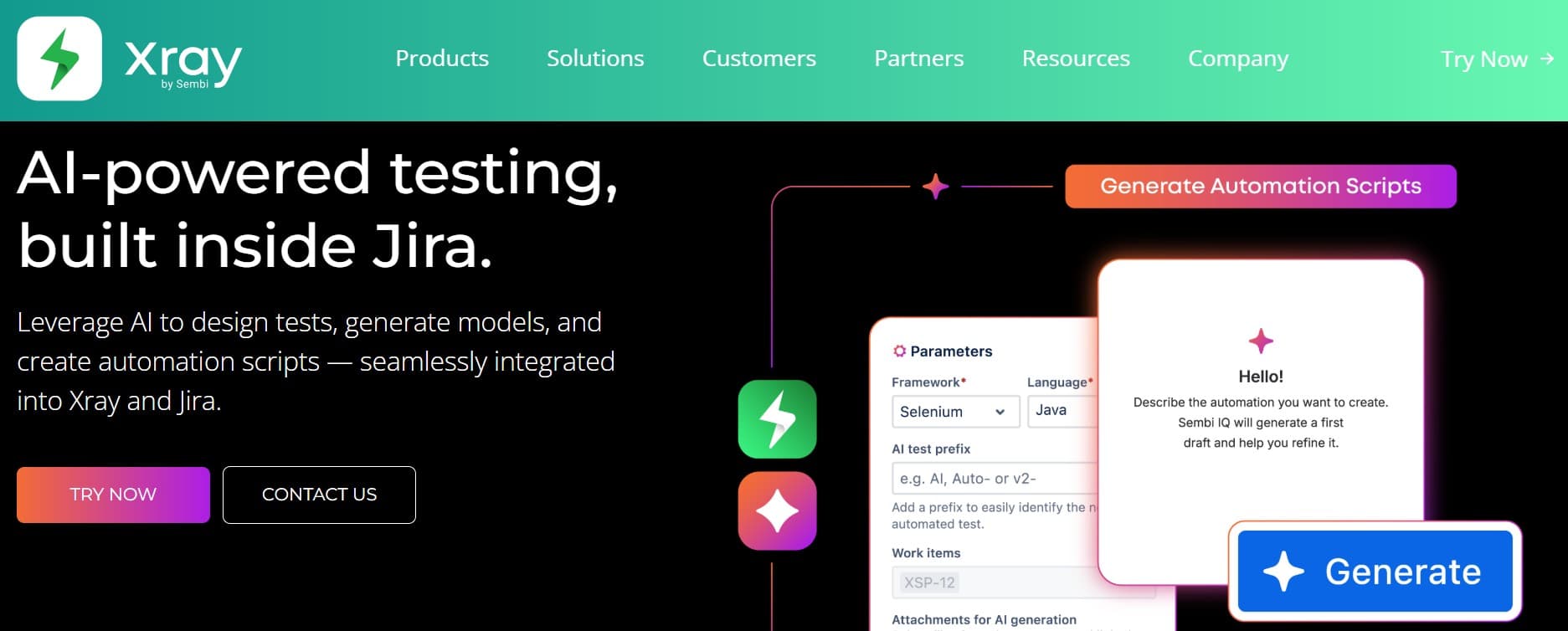
Xray (Xpand IT) is the most flexible of the Jira-native options. Cases are first-class Jira issues, BDD/Gherkin support is genuinely deep, and the REST and GraphQL APIs are well-documented enough that custom CI workflows are real engineering work rather than improvisation.
Key features:
- Test cases as Jira issues with native rights and visibility.
- Native Cucumber and BDD/Gherkin support.
- Xray REST API plus Xray GraphQL for advanced integrations.
- Support for manual, automated, exploratory, and cucumber test types.
- Test plans, test sets, and test executions as separate issue types.
- Integration with Jenkins, GitHub Actions, GitLab CI, Bitbucket Pipelines, Azure DevOps, Bamboo, CircleCI.
- Support for both Jira Cloud and Jira Data Center.
Where it wins vs. Qase:
- Engineering teams already in Jira adopt with near-zero cognitive switch.
- BDD support is meaningfully deeper.
- Native Jira rights model means cross-team visibility doesn't need extra licenses.
- Stronger fit if your developers are writing tests rather than QA-only.
Where another tool fits better:
- UI inherits every Jira quirk; steeper learning curve for non-engineering users.
- QA-centric workflows feel more native in Qase.
- AI authoring is limited.
- Performance in very large test repositories needs careful configuration.
Best for: Jira-centric engineering orgs where developers contribute tests and BDD or a strong API surface is part of the workflow.
Choose this if Jira is the center of gravity and you want flexibility, BDD support, and a strong API surface.
4. Zephyr Scale: enterprise Jira polish
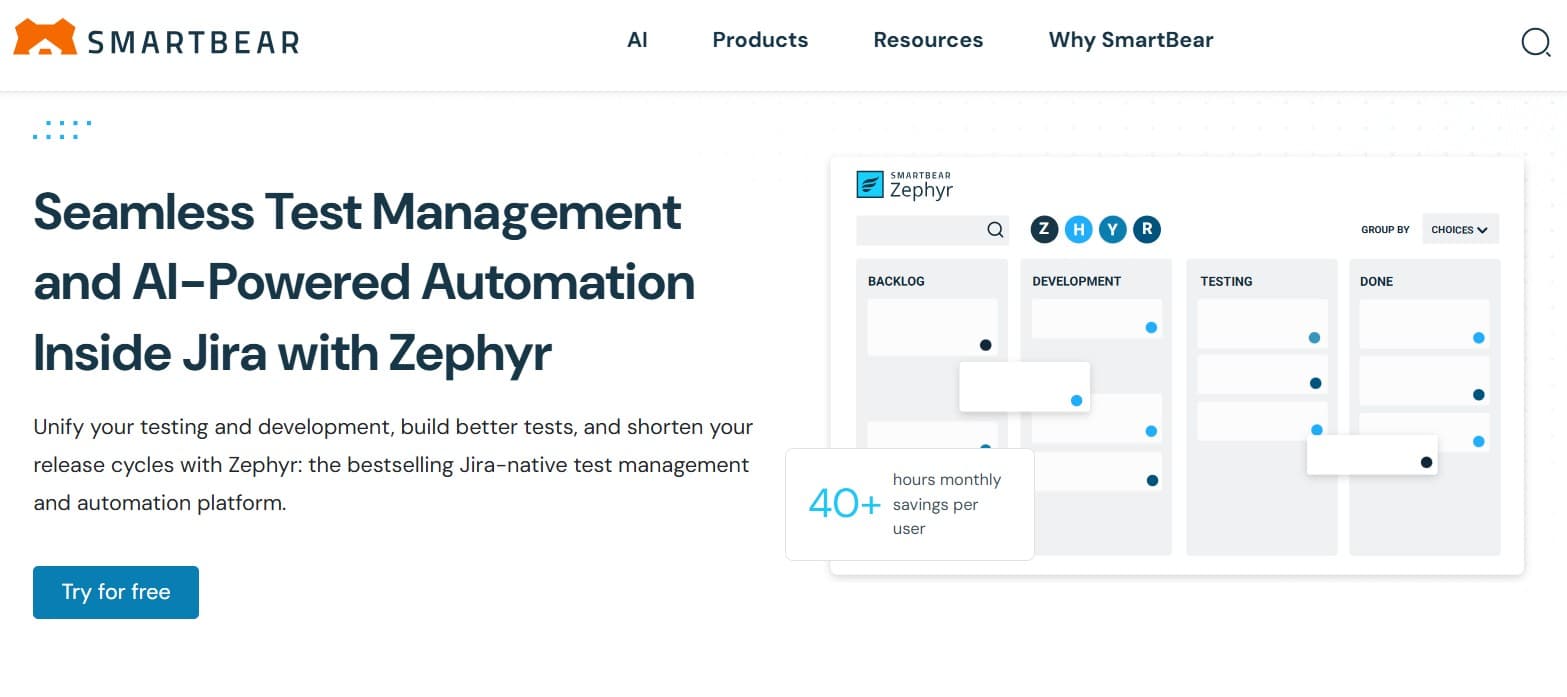
Zephyr Scale (SmartBear, previously TM4J) is the more polished Jira-native option. Cleaner test case organization than Xray, stronger cross-project reporting, a Jira integration that feels purpose-built. Large enterprise Jira programs tend to land here.
Key features:
- Hierarchical folders and parameterized test cases.
- Cross-project reporting and dashboards for engineering leadership.
- Test plan and test cycle management with planning views.
- Native Confluence integration alongside Jira.
- REST API and integration with major CI providers (Jenkins, GitHub Actions, Bamboo, GitLab).
- Custom field support that doesn't require Jira admin work.
- Bulk operations and import/export tooling.
Where it wins vs. Qase:
- Cross-team reporting at enterprise scale is genuinely strong.
- Test case organization is cleaner than Qase's for very large repositories.
- Confluence integration helps teams that document requirements there.
- Per-project configuration with shared reporting across.
Where another tool fits better:
- Cost at scale is not a small line item; Qase is meaningfully cheaper.
- AI features are still limited.
- Less flexibility than Xray for unusual data models.
- Smaller teams won't use the enterprise reporting depth that justifies the price.
Best for: large Jira-centric orgs with multiple QA teams, cross-team reporting requirements, and budget for enterprise polish.
Choose this if you're a global enterprise on Jira and you're willing to pay for the polish.
5. qTest: heavyweight for regulated programs
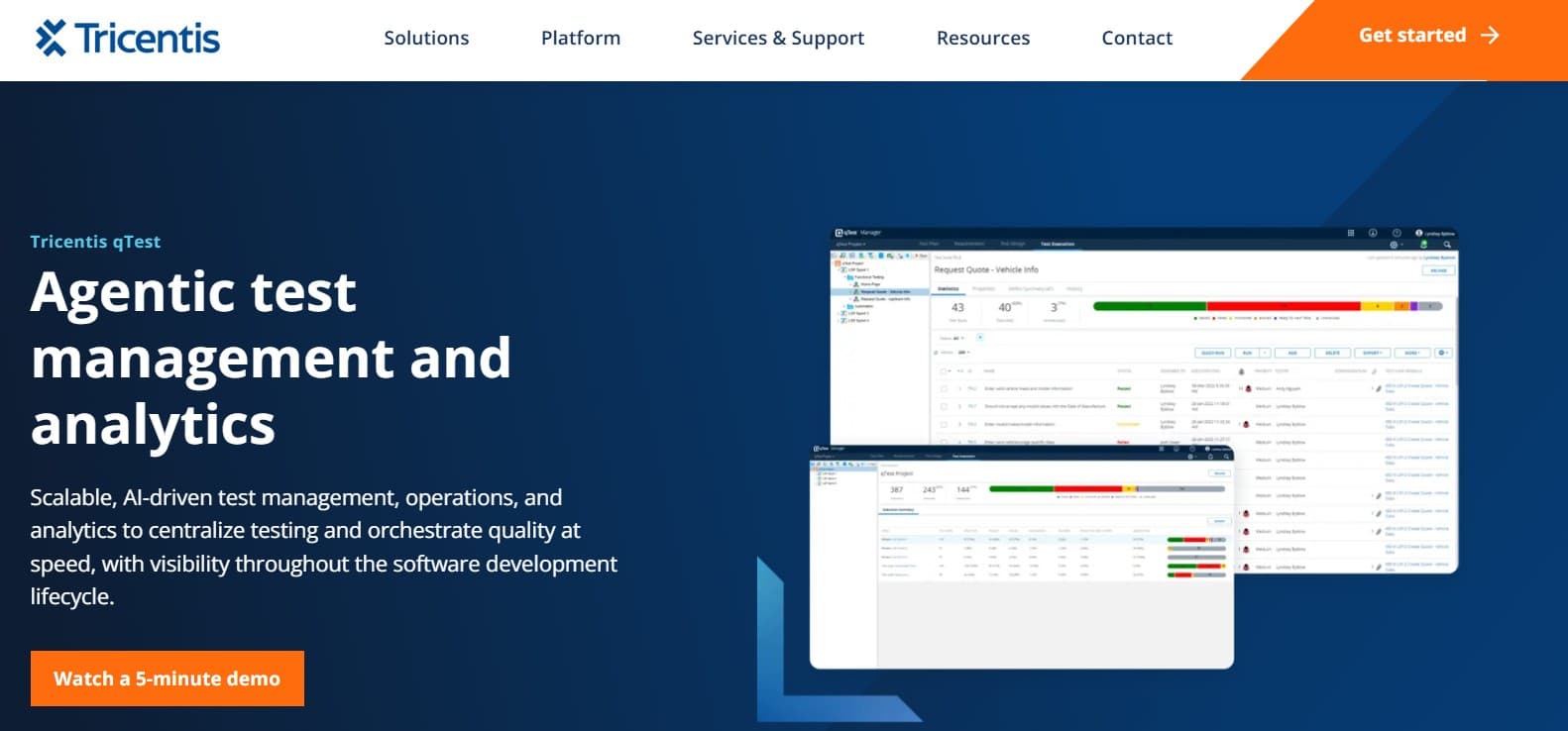
Tricentis qTest is the test management tool of choice for many large regulated QA programs. Deep requirements traceability, audit history, admin controls that compliance teams can defend, integration with the wider Tricentis platform (Tosca, qTest Pulse, qTest Explorer). For a fuller picture, see best qTest alternatives.
Key features:
- Deep requirements traceability with linkage from issues to runs.
- Audit history with role-based access and approval workflows.
- Integration with Tosca, qTest Pulse (insights), qTest Explorer (exploratory).
- Support for Jira, ALM, and major DevOps tooling.
- Compliance certifications relevant to regulated industries.
- Multi-org admin model designed for global QA programs.
Where it wins vs. Qase:
- Audit and traceability depth meaningfully exceeds Qase.
- Admin model holds up for global QA programs Qase wasn't built for.
- Integration with Tosca for teams already in the Tricentis stack.
- Long shelf of compliance certifications.
Where another tool fits better:
- Cost and implementation effort are significant; Qase is cheaper and faster to adopt.
- Heavy for mid-size or growth-stage QA orgs.
- AI features are bolted on rather than central; an AI-native tool fits better if AI is the reason you're moving.
Best for: large enterprises in regulated industries (pharma, banking, medical devices) where audit depth justifies the cost.
Choose this if you're scaling into a regulated footprint Qase doesn't support and AI isn't the primary requirement.
6. Testiny: simple, fast, opinionated
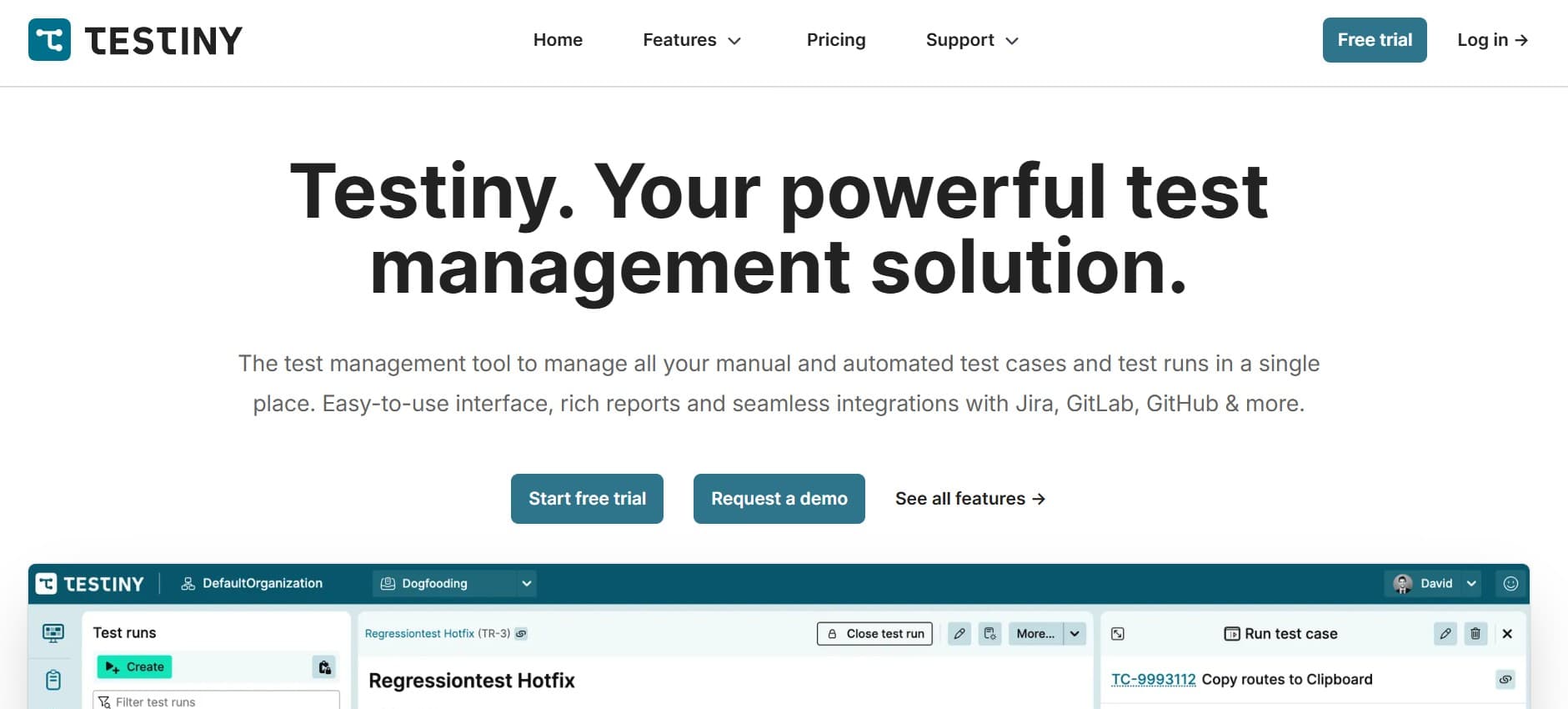
Testiny is one of the newer arrivals. Small, opinionated, fast. It doesn't try to be everything. For small QA teams that want something that just works, it's a fair pick.
Key features:
- Clean, opinionated UI focused on simplicity.
- Test cases, test runs, and milestones.
- REST API with the basics covered.
- Jira integration with linked-issue support.
- CI integration with major providers.
- Free tier for very small teams.
Where it wins vs. Qase:
- Even simpler than Qase; ramp-up is minimal.
- Pricing is friendly for small teams.
- Opinionated workflow reduces decision fatigue.
Where another tool fits better:
- Fewer integrations than Qase.
- Smaller ecosystem.
- Lighter on AI and compliance.
- Not a fit for a large QA org with regulated workflows.
Best for: small QA teams that want minimal, opinionated test management without a learning curve.
Choose this if you want a slightly simpler step than Qase and your team doesn't need deep customization.
7. Allure TestOps: automation-first management
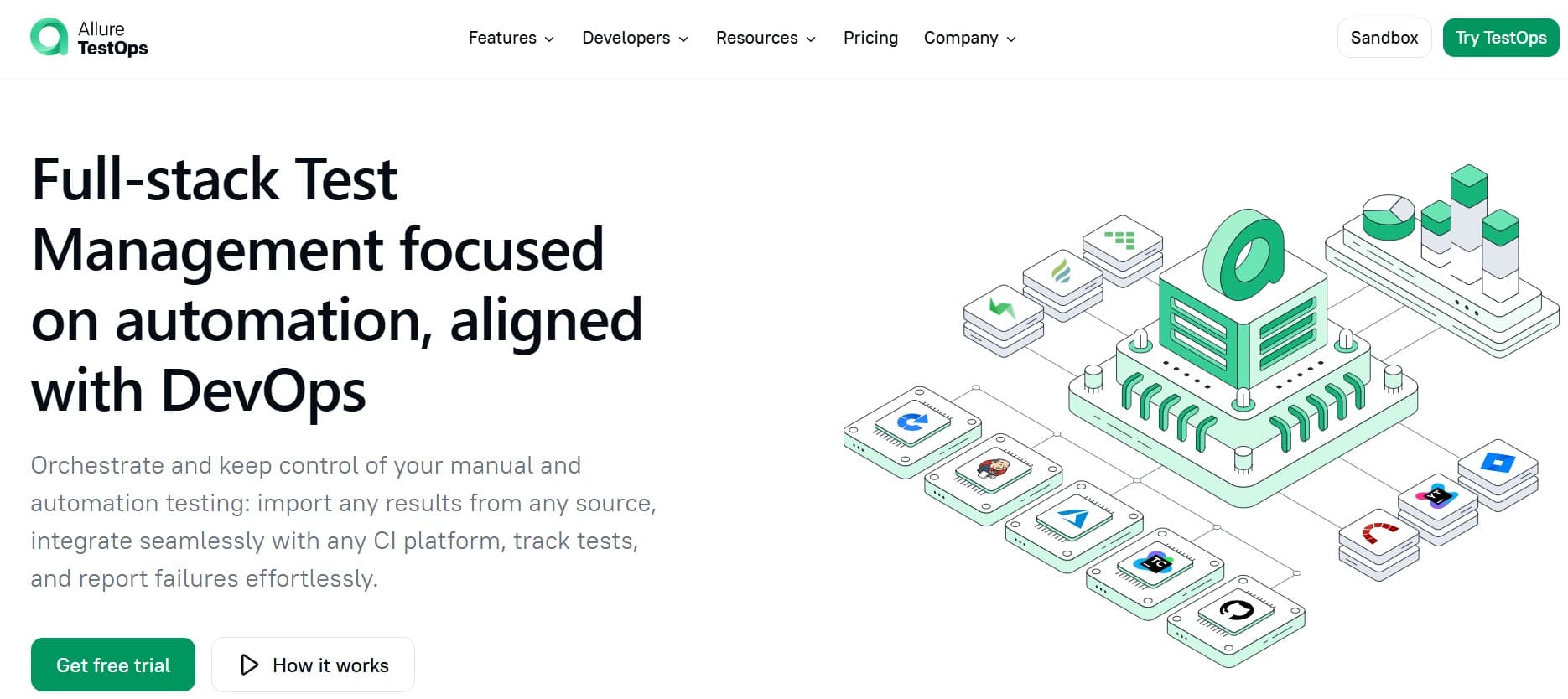
Allure TestOps is built around the Allure reporting framework that many automation engineers already use. If your QA org is automation-heavy and Allure reports are part of the daily workflow, the management layer plugs in naturally.
Key features:
- Native Allure Reports integration across JUnit, TestNG, pytest, Mocha, Jest, NUnit, xUnit, and more via Allure adapters.
- Test launches aggregating scripted runs across many frameworks.
- Flake detection and quarantine workflows for automation suites.
- Test case management linked to automation execution by ID.
- Jira and TestRail integration.
- Live test results streaming from CI pipelines.
- On-premise deployment for teams that need it.
Where it wins vs. Qase:
- Tight integration with automation-first workflows; Qase treats automation as secondary.
- Reporting depth on automation suites is strong out of the box.
- Engineering teams writing tests in code feel at home.
Where another tool fits better:
- Manual-test-case workflows are less mature than Qase's.
- AI authoring isn't a first-class capability.
- Mixed manual/automation QA orgs find Qase a better fit.
- Compliance depth is moderate.
Best for: automation-heavy QA orgs already living in Allure reports.
Choose this if your suite is mostly automated and Allure reports are already how your team thinks about results.
Tool comparison summary
| Tool | Strengths | Limitations | Best for |
|---|---|---|---|
| qtrl | AI authoring + agentic execution + audit in one platform | Newer than incumbents; fewer legacy compliance certs | Teams that want unified management + AI execution |
| TestRail | Familiar, broad community, wide CI/Jira integration | 2010s core; sideways move if AI is the reason | Familiar workflow over AI |
| Xray | Jira-native, deep BDD, strong APIs | Jira-quirky UI; limited AI authoring | Jira-centric engineering orgs |
| Zephyr Scale | Enterprise Jira polish, cross-team reporting | Cost at scale; limited AI | Large Jira-centric enterprises |
| qTest | Audit depth, traceability, Tricentis ecosystem | Cost, implementation effort, AI is bolt-on | Large regulated programs |
| Testiny | Simple, opinionated, friendly pricing | Fewer integrations, lighter AI/compliance | Small teams that want simplicity |
| Allure TestOps | Automation-first, Allure-deep, CI-native | Less mature manual workflows; AI not first-class | Automation-heavy teams in Allure |
How to migrate off Qase without breaking flow
Qase is cleaner to migrate off than most older tools, but the cutover still has predictable failure modes. A pragmatic playbook:
- Export a real project, not the sample. Pull a real messy project (broken links, half-orphaned cases, long run history) into the candidate tool. Two hours of that beats five sales calls.
- Map custom fields explicitly. Qase's custom fields are the most common source of migration friction. Decide which ones move and which ones get dropped before the import runs.
- Preserve Qase case IDs as metadata. Keep them on the imported case for traceability in old links, even if you generate new IDs in the destination tool.
- Wire CI before the cutover. The first release on the new system should pass through unchanged CI. Add the new tool's API calls to your pipeline, dual-write for a sprint, then cut over.
- Have someone outside QA find a test result. Hand the new tool to a developer or PM. Ask them to find the test status of last week's feature. If they can't do it without help, the visibility problem isn't solved yet.
- Pick a cutover date and stop dual-writing. Most stalled migrations are teams running both tools indefinitely because nobody committed. Freeze Qase as read-only on day X. Make the new tool the source of truth.
Where qtrl fits in a post-Qase stack
The pitch is straightforward. Qase modernized test management without rethinking it. The teams that move on want a tool that did rethink it: AI as the daily authoring path, agents driving real browsers, manual and AI runs in one history, audit primitives that satisfy modern frameworks without bolt-on integrations, adaptive memory so the system learns the patterns of your app across runs, and progressive autonomy so you decide how much initiative the agent takes on each flow.
For teams shipping AI features themselves, the audit angle isn't optional anymore. We covered the broader frame in testing non-deterministic AI under the EU AI Act and what is agentic testing.
Frequently asked questions
What's the best Qase alternative in 2026? It depends on what's pulling you away from Qase. qtrl for AI execution and unified management. TestRail for familiar workflow. Xray for Jira-native flexibility. Zephyr Scale for enterprise Jira polish. qTest for large regulated programs. Testiny for simpler workflow. Allure TestOps for automation-heavy teams.
Is Qase still good in 2026? Yes, for the case it was designed for. Clean modern test management with a familiar workflow, usable free tier, modern UI. Teams that move on usually do so because they want capabilities Qase wasn't designed to deliver, not because Qase failed at its job.
Does Qase have real AI features? Yes, added through 2025 and 2026: case generation, defect summarization, suite analysis. Useful on the margins. The shape is additions on top of a non-AI core, which is the right approach if you don't want AI to change the workflow shape, and the limiting factor if you do.
Can I migrate from Qase to another tool? Yes. Most of the tools on this list have Qase import paths or can ingest a common CSV/JSON export. Run the import on a real messy project, not the sample.
What's the difference between Qase and TestRail? Both are test management tools with similar data models. Qase is newer and has a more modern UI; TestRail has wider community knowledge and broader integration coverage. For most teams the answer is closer to "both work, pick the one your team likes" than to a clear winner.
Does Qase support the EU AI Act? Qase has the basic audit primitives most teams need, but the deeper evidence shape regulators ask for under the EU AI Act (immutable run history, agent provenance, signed evidence) is light. For teams shipping AI features that will face regulatory review, a tool with deeper audit primitives is the safer pick.
How long does a Qase migration take? Faster than off older tools. A small QA org can cut over in one to two weeks. A larger team with custom fields and several active projects might take three to four weeks. Plan for two weeks of cutover regardless.
Should I keep my existing Playwright suite when moving off Qase? Usually yes. Decoupling the management layer from the execution framework is the right call. Move cases first, point the same automation at the new tool through its CI integration, and only revisit framework choice once the management migration is stable.
What others say about Qase
The Qase reviews on G2 echo most of the points above. A few that come up repeatedly:
“Qase’s AI assistant makes step editing unpredictable. Deleting a step also deletes pauses, the AI can regenerate previously removed steps, and there is no way to lock steps or manage them in bulk.”
G2 reviewer, QA Engineer (Mid-Market) · G2 reviews
“Qase becomes less smooth on large test suites, especially around filtering and navigation, and the reporting is too limited for richer custom insights.”
G2 reviewer, Software Engineer (Mid-Market) · G2 reviews
“Some features are not clearly laid out at first and the workflow takes time to feel natural.”
G2 reviewer, CRM Developer (Mid-Market) · G2 reviews
Two checks before you switch
First, take a real project (not a demo) and try to recreate one week of work in the new tool. Not just the happy path: edge cases, broken links, half-orphaned cases, a flaky run history. The tool that handles your mess gracefully is the one that'll keep handling it next year.
Second, hand the tool to someone outside QA. A developer or a PM. If they can't find the test status of the feature they shipped last week without help, the visibility problem isn't solved. That's the failure mode worth checking before commit.
If structured test management with AI agents that actually run tests is what you were hoping Qase would grow into, qtrl was built for that combination. Try it out and see how it fits.
Have more questions about AI testing and QA? Check out our FAQ