
Best test case management tools in 2026: 7 picks
By qtrl Team · Engineering
Every test case management vendor checks the same boxes on the buyer's spreadsheet. The differences only show up after three months of real use, which is the wrong time to learn them. The seven test case management tools below cover the credible 2026 shortlist, with the differences that emerge once the feature matrix stops being useful. Vendor disclosure: qtrl is on the list.
TL;DR: the seven test case management tools that actually compete
For unified test case management plus AI execution, qtrl. For familiar dedicated QA workflow, TestRail. For a clean modern mid-weight option, Qase. For Jira-native flexibility and BDD depth, Xray. For polished enterprise reporting across many Jira teams, Zephyr Scale. For large regulated QA programs, qTest. For mid-size regulated teams that need traceability without enterprise weight, PractiTest. Pricing varies per vendor and per tier; pull current numbers from each sales team.
What test case management still has to do in 2026
Test case management used to be a spreadsheet replacement. In 2026, it sits in a more interesting position: it's the system of record for what got tested, by whom or what, against what version, with what result. That responsibility has gotten heavier as AI features ship into production and regulators ask for evidence the management layer is best placed to produce.
Most management tools were designed before AI execution was a real option. They handle cases and runs cleanly, but execution still lives in a separate Playwright or Cypress repo, and AI features are added on top of a non-AI core. The newer entrants treat execution and management as one system. The split between those two architectures is the most important thing in this category right now. For deeper context on why structured management still matters, see why structured test management still matters.
What to look for in a test case management tool
Nine criteria that decide a real evaluation:
- Where the work happens. Jira-native versus external with sync. Neither is better; they fit different QA cultures.
- Case versioning and review. Diffs, approvals, rollback. Without versioning, a structured tool is just a slower spreadsheet.
- Audit and traceability depth. Immutable run history, requirement-to-case-to-run links, role-based access. For regulated work this is the first filter.
- Compliance posture. The EU AI Act, NIST AI Risk Management Framework, and ISO/IEC/IEEE 29119 all expect specific evidence shapes; older tools struggle to produce them without bolt-on work.
- AI authoring quality. Most modern tools can produce something from a PRD. Test it on a real PRD before you trust it on a live project.
- Agentic execution. Does the tool drive a browser or just record results from somewhere else? The answer changes the audit story end-to-end.
- Automation coupling. Integration depth with Selenium, Playwright, Cypress, and CI providers (GitHub Actions, GitLab CI, Jenkins, CircleCI, Bitbucket Pipelines, Azure DevOps).
- Reporting depth. Cross-project coverage, defect leakage by release, release readiness. The reports an engineering leader will open in a quarterly review.
- Team size and shape. A tool that fits a ten-person QA team is rarely the same one that fits a 200-person global program. Match the upgrade to where you'll be in twelve months.
Test case management tools compared at a glance
| Tool | Best for | Case versioning + review | Immutable audit trails | AI authoring + execution |
|---|---|---|---|---|
| qtrl | AI execution + management | ✓ | ✓ | ✓ |
| TestRail | Familiar default | ✓ | ! basic history | ! recent additions |
| Qase | Clean modern mid-weight | ✓ | ! basic history | ! catching up |
| Xray | Jira-native flexibility | ✓ | ✓ | ! limited authoring |
| Zephyr Scale | Enterprise Jira polish | ✓ | ✓ | ! basic suggestions |
| qTest | Large regulated programs | ✓ | ✓ | ! moderate |
| PractiTest | Mid-size regulated teams | ✓ | ✓ | ✗ |
1. qtrl: management plus AI execution in one platform
qtrl is the AI-native option. Structured cases with versioning and review, manual and AI execution in the same run, adaptive memory that learns your app over time, and immutable audit history out of the box. Most management tools stop at cases and runs. qtrl extends through execution while keeping the management layer intact.
Key features:
- Versioned test cases with branchable history and review-gated changes.
- AI authoring from PRDs, user stories, design specs, and exploratory sessions.
- Agentic browser execution with progressive autonomy (you set the level of agent initiative per flow).
- Adaptive memory: agents learn your app's patterns across runs.
- Manual and AI execution in the same run, with one unified history.
- Immutable audit trail produced as a side-effect of normal work.
- Two-way Jira integration with linked issues, status updates, and defect creation.
- CI hooks for GitHub Actions, GitLab CI, Jenkins, CircleCI, Bitbucket Pipelines, Azure DevOps.
Where it wins:
- AI is woven into authoring and execution, not added on top of a pre-AI core.
- Manual + AI execution share one run history.
- Audit shape fits EU AI Act and NIST AI RMF without bolt-on integrations.
- Lighter implementation effort than enterprise incumbents at comparable scale.
- One platform for cases, runs, AI execution, and audit, rather than three stitched together.
Where another tool fits better:
- If your QA org is large enough that a deep shelf of legacy compliance certifications matters more than AI capability, the enterprise incumbents have more paperwork already collected.
- If your team isn't ready to weave AI into the daily workflow yet, a simpler tool like Qase or TestRail is a gentler ramp.
- If your engineering team strongly prefers tests as first-class Jira issues, Xray or Zephyr fit that shape better.
Best for: teams that want unified test management plus AI browser execution, progressive automation with human oversight, and the evidence shape modern regulations expect.
Choose this if you want one platform for cases, runs, AI execution, and audit, especially if you're shipping AI features that need documented evidence.
2. TestRail: the familiar default
TestRail (Idera) is the most widely deployed test management tool in the world, which means many QA engineers already know it. The data model is well-trodden, the community resources are deep, and recent AI additions help on the margins. We've covered the broader picture in best TestRail alternatives in 2026.
Key features:
- Test case repository with suites, sections, and milestones.
- Test runs and test plans with configurable workflows.
- Integration with most major CI tools, Jira, Bugzilla, GitHub, GitLab.
- REST API with broad coverage.
- Recent AI features for case suggestions, summarization, and run analysis.
- Customizable case templates and fields.
Where it wins:
- Familiarity: most QA engineers ramp quickly.
- Deep community resources.
- Broad ecosystem of integrations.
- Lower cost than enterprise heavyweights at comparable scale.
Where it falls short:
- AI features sit on a 2010s-era core architecture.
- Audit history is lighter than enterprise compliance tools.
- Product evolves slowly compared to newer entrants.
- Community reports flag slow support response at the lower tiers.
Best for: teams that want a familiar dedicated QA tool with broad community knowledge, where AI isn't the primary decision factor.
Choose this if you want a familiar tool with a wide community and AI isn't the headline reason for picking.
3. Qase: the clean modern mid-weight
Qase is the cleanest modern mid-weight option. Modern UI, a usable free tier, real CI integrations, a public API that doesn't feel like an afterthought. AI features are improving but still catching up to AI-native tools.
Key features:
- Modern UI optimized for QA daily workflow.
- Free tier usable for small teams; paid tiers for advanced features.
- Real CI/CD integrations (GitHub Actions, GitLab CI, Jenkins, CircleCI, Bitbucket Pipelines).
- Public REST API with comprehensive coverage.
- AI features for case generation, defect summarization, and suite analysis.
- Two-way Jira integration with linked-issue support.
- Native support for behavior-driven tests and parameterized cases.
Where it wins:
- Modern UX with short ramp-up.
- Free tier keeps total cost down at growth stage.
- Broad API surface for custom workflows.
- AI features improving meaningfully each quarter.
Where it falls short:
- Compliance depth is lighter than enterprise tools.
- AI sits on top of a non-AI core.
- Reporting depth at large scale isn't at qTest or Zephyr Scale level.
Best for: small to mid-size teams wanting a modern UX and a real API without enterprise pricing.
Choose this if you want a modern tool with low onboarding cost and you don't need deep regulated-industry depth.
4. Xray: Jira-native flexibility
Xray (Xpand IT) is Jira-native. Tests are first-class Jira issues. Cucumber, BDD, a deep API, and broad data-model flexibility. Strong fit for engineering-led QA in a Jira-centric org.
Key features:
- Test cases as Jira issues with native rights and visibility.
- Native Cucumber and BDD/Gherkin support.
- REST API and a separate Xray GraphQL API for CI integration.
- Test plans, test sets, and test executions as separate issue types.
- Support for manual, automated, exploratory, and Cucumber test types.
- Integrations for Jenkins, GitHub Actions, GitLab CI, Bitbucket Pipelines, Azure DevOps.
Where it wins:
- Engineering teams in Jira adopt with near-zero cognitive switch.
- BDD support is genuinely first-class.
- REST and GraphQL APIs support real CI integration.
- Native Jira rights mean cross-team visibility doesn't need extra license tiers.
Where it falls short:
- UI inherits every Jira quirk.
- Custom approval workflows are thinner than dedicated tools.
- AI authoring is still limited.
- Performance can degrade in very large repositories without careful configuration.
Best for: Jira-centric engineering orgs where developers contribute tests and BDD or a strong API surface matters.
Choose this if Jira is the center of gravity and you want flexibility.
5. Zephyr Scale: enterprise Jira polish
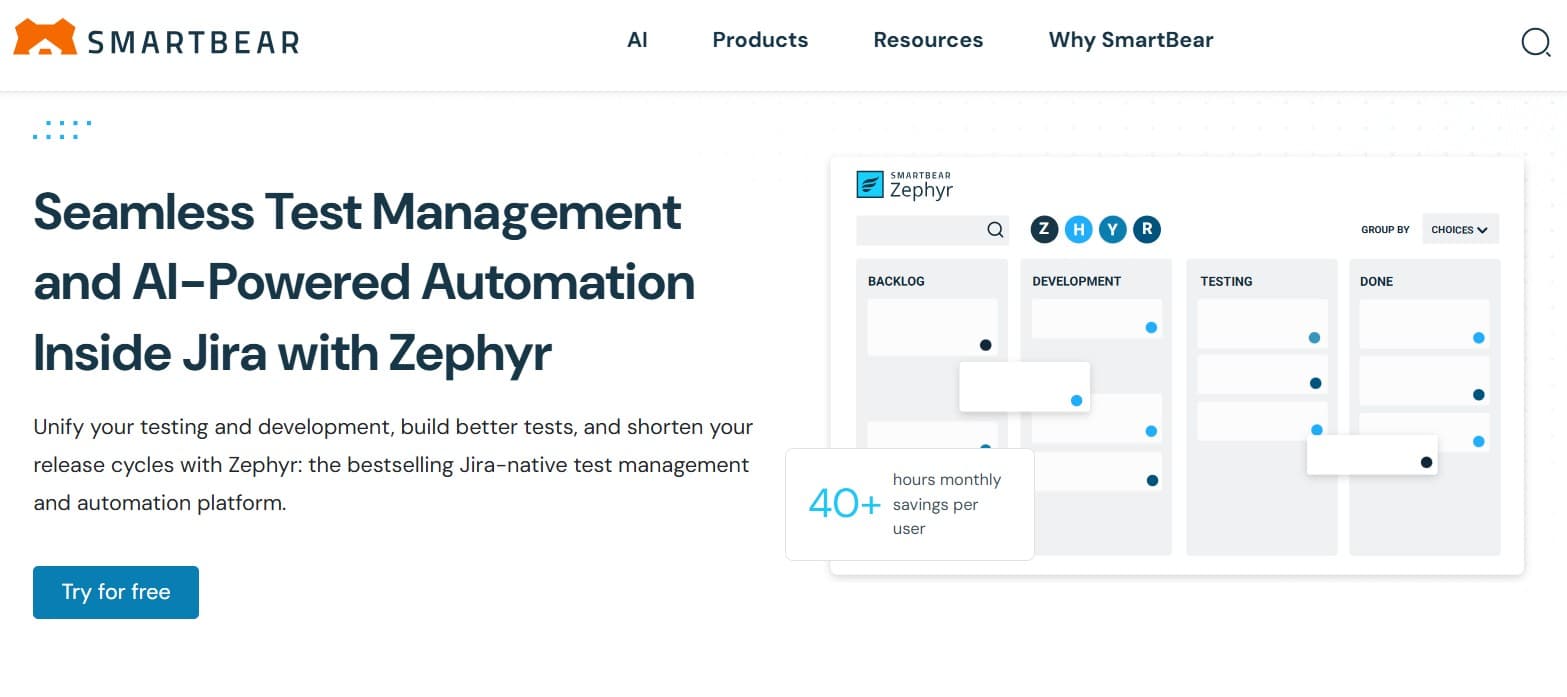
Zephyr Scale (SmartBear, formerly TM4J) is the polished Jira-native option. Cleaner case organization than Xray, stronger cross-project reporting, enterprise tone. Suits large Jira-centric programs running multiple QA teams.
Key features:
- Hierarchical folders and parameterized test cases.
- Cross-project reporting and dashboards for engineering leadership.
- Test plan and test cycle management with planning views.
- Native Confluence integration alongside Jira.
- REST API and integrations with major CI providers.
- Custom field support that doesn't require Jira admin work.
Where it wins:
- Genuine enterprise reporting depth.
- Cleaner case organization than Xray.
- Mature Jira integration that feels purpose-built.
- Confluence link helps for teams that document requirements there.
Where it falls short:
- Cost at scale is a real line item.
- AI features are limited.
- Less flexible than Xray for unusual data models.
Best for: large Jira-centric orgs with multiple QA teams and cross-team reporting requirements.
Choose this if you're a large Jira-centric org that needs cross-team reporting.
6. qTest: the enterprise heavyweight
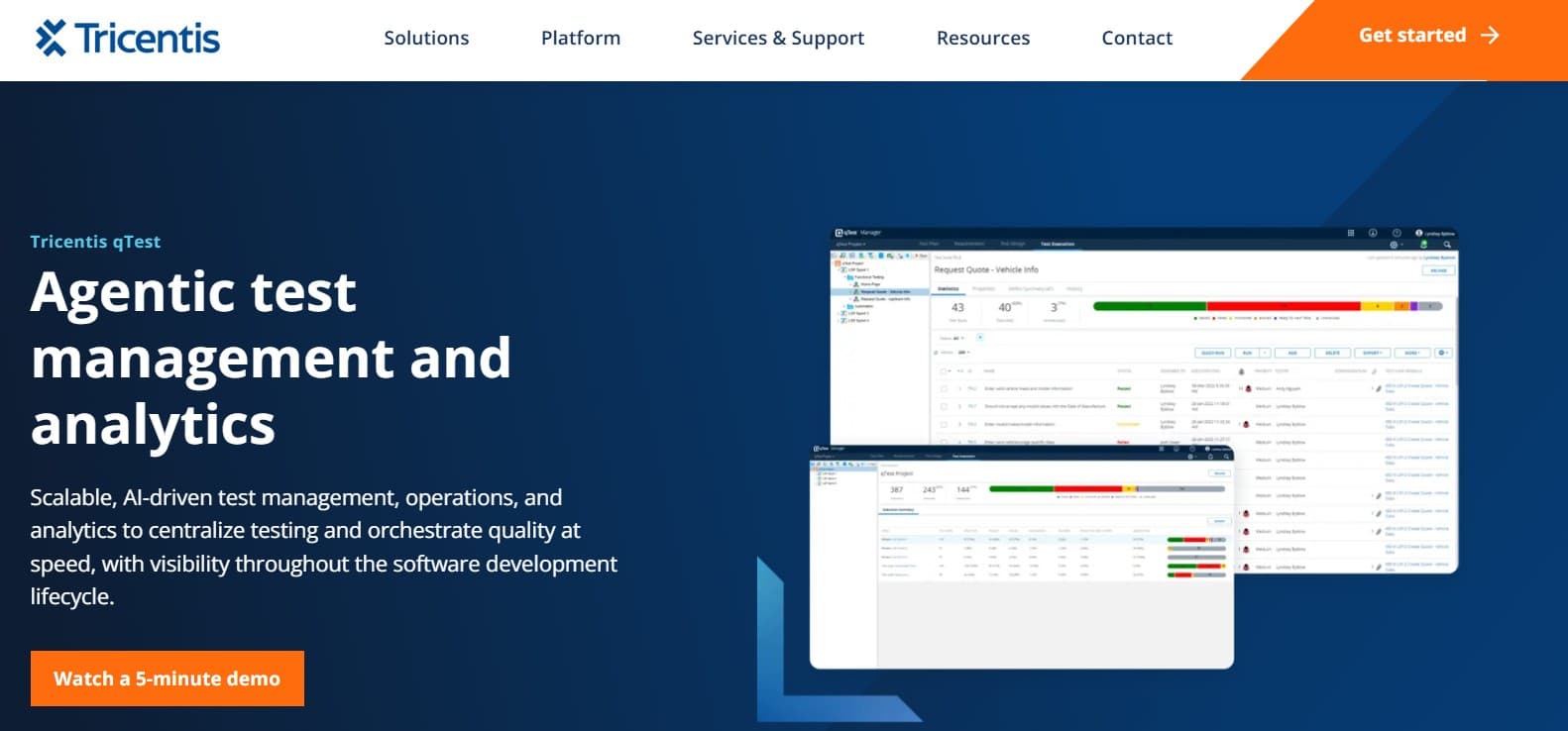
qTest (Tricentis) is the enterprise heavyweight. Strong on traceability, audit history, and admin controls. Heavy on cost and implementation effort. For deeper coverage of where qTest fits and where it doesn't, see best qTest alternatives.
Key features:
- Deep requirements traceability from issues through to runs.
- Role-based access designed for compliance audits.
- Integration with the wider Tricentis platform (Tosca, qTest Pulse, qTest Explorer).
- Two-way Jira sync with linked-issue and defect support.
- Custom workflows for enterprise QA programs.
- Built for global QA orgs spanning many teams and geographies.
Where it wins:
- Compliance and audit posture for regulated industries is genuinely deep.
- Cross-program reporting at enterprise scale is strong.
- Admin model handles global QA orgs cleanly.
- Integration with Tosca matters when both are already in play.
Where it falls short:
- Heavyweight by design; wrong fit for growth-stage QA orgs.
- AI features are bolt-ons rather than woven into the core workflow.
- Pricing scales fast at the enterprise tier.
- Implementation effort is non-trivial.
Best for: large regulated enterprises in pharma, banking, or medical devices.
Choose this if you're a large regulated QA program and need enterprise depth.
7. PractiTest: traceability for mid-size regulated teams
PractiTest sits between Qase and the enterprise options. Strong on traceability and reporting for mid-sized regulated teams (healthcare, fintech, medical-device-adjacent software). UI is functional, not pretty.
Key features:
- Hierarchical traceability from requirements to runs.
- Custom fields, custom views, and customizable workflows.
- Two-way Jira integration with bidirectional sync.
- Integration with major automation frameworks (Selenium, Playwright, Cypress, JMeter) via REST API.
- Built-in defect management or integration with Jira, Mantis, Bugzilla.
- HIPAA, SOC 2, and ISO 27001 certifications.
Where it wins:
- Lower implementation cost than qTest at comparable compliance posture.
- Deep traceability without enterprise heroics.
- Mid-size pricing tier accessible to teams that can't justify qTest.
- Workable UI for QA daily flow.
Where it falls short:
- UI is functional, not delightful.
- AI capabilities are minimal.
- Ecosystem smaller than Xray, Qase, or qTest.
- Reporting depth at the very largest scale doesn't match qTest.
Best for: mid-sized regulated teams (healthcare, fintech, medical-device-adjacent) needing traceability without enterprise weight.
Choose this if you're a mid-sized regulated team that needs traceability without enterprise weight.
Tool comparison summary
| Tool | Strengths | Limitations | Best for |
|---|---|---|---|
| qtrl | AI authoring + agent execution + management + audit | Newer entrant; fewer legacy compliance certs | Unified AI execution + management |
| TestRail | Familiar, broad CI/Jira, lower cost | 2010s core; lighter audit; slow evolution | Familiarity over AI |
| Qase | Clean modern UX, free tier, growing AI | AI on non-AI core; lighter compliance | Modern mid-weight swap |
| Xray | Jira-native flexibility, BDD depth, strong APIs | Jira-quirky UI; limited AI authoring | Jira-centric engineering orgs |
| Zephyr Scale | Enterprise polish, cross-team reporting | Cost at scale; limited AI | Large Jira-centric enterprises |
| qTest | Compliance depth, enterprise admin, Tosca stack fit | Heavyweight; AI bolt-on; high implementation cost | Large regulated programs |
| PractiTest | Mid-size traceability, HIPAA/SOC 2/ISO 27001 | Plain UI; minimal AI; smaller ecosystem | Mid-size regulated teams |
How to evaluate without buying the wrong size
Test management tools are sticky. Once cases are in, exports are messy, and the team learns the quirks of the UI, the cost of switching is real. That makes the wrong pick expensive for longer than anyone wants to admit. A pragmatic playbook:
- Optimize for the workflow you have today. Leave headroom for one layer of growth. Don't buy depth you can't articulate a use case for.
- Run a real migration in the trial. Not a curated import: a real project with broken links, half-orphaned cases, and run history that goes back too far.
- Map fields before you import. Custom fields are where most migrations break. Document, decide, and don't preserve fields nobody uses.
- Set up CI integrations before the cutover. The first release run on the new tool should pass through unchanged CI.
- Have compliance walk through evidence generation. Ask your auditor or compliance lead to produce the evidence they'd hand to a regulator from the new tool.
- Plan the cutover, not just the migration. Pick a date, freeze the old tool as read-only, and make the new tool the source of truth from day one.
Where qtrl fits in a modern test management stack
Most test case management tools were designed before AI execution was a real option. They handle cases and runs cleanly, but execution lives in a separate Playwright or Cypress repo, and AI features are added on top of a non-AI core. qtrl is built around AI execution being part of the management system rather than next to it, with progressive autonomy (you choose how much initiative agents take) and human oversight on the steps that matter.
For teams shipping AI features, the timing matters. The EU AI Act phased obligations through 2026 introduce real requirements around testing, traceability, and documentation. Regulated teams shipping AI features need a single record of what was tested and how, not three systems they have to correlate at audit time. The ISTQB Foundation syllabus is the cleanest vendor-neutral view of what a test management process should cover, regardless of which tool runs it.
Frequently asked questions about test case management tools
What is the best test case management tool in 2026? For unified AI execution and management, qtrl. For familiar workflow, TestRail. For modern mid-weight, Qase. For Jira-centric, Xray or Zephyr Scale. For large regulated programs, qTest. For mid-size regulated teams, PractiTest.
Is TestRail still the standard? It's still the most widely deployed, but no longer the obvious default. A growing share of teams are evaluating modern alternatives, especially where AI and compliance depth matter. See why QA teams are leaving TestRail.
How much does test case management cost? Most tools price per active QA seat with public tiers ranging from free starter plans (Qase, Testiny) through enterprise licensing for qTest, Zephyr Scale, and Tosca. Pull current pricing from each vendor before budgeting. The real cost is rarely the license, though; it's the ongoing maintenance and the friction the tool adds to engineering. See the real cost of test automation.
Do I need test case management if my tests are all automated? Yes, in most cases. Even for fully automated suites, you still need versioned intent, run history, and evidence for compliance. A Git repo of scripts isn't a management system.
Which test case management tool has the best AI features? qtrl is the most AI-native (agentic execution, AI authoring, adaptive memory, progressive autonomy). Qase and TestRail have AI additions on non-AI cores. Xray, Zephyr Scale, qTest, and PractiTest are not primarily AI-driven products.
How does test case management relate to agentic testing tools? They solve adjacent jobs. Test case management is the system of record for what got tested and what the result was. Agentic testing tools drive the browser to actually run the tests. The cleanest setups keep both in one place, so the run history and the execution aren't two systems you reconcile at audit time. For the execution side specifically, see best agentic testing tools.
Can I migrate test cases between management tools? Yes, and most vendors advertise importers for the major competitors. Run any import on a real, messy project before committing. A demo import is not a migration test.
Jira-native or external test management? Jira-native (Xray, Zephyr) suits engineering-led teams that want tests as Jira issues. External (TestRail, Qase, qTest, PractiTest, qtrl) suits teams that want a dedicated QA workspace with Jira linked rather than embedded. Both are valid; neither is universally better.
Does test case management tool choice affect EU AI Act compliance? It affects how easy compliance is, not whether you can achieve it. Tools that produce immutable evidence as a byproduct of normal work are easier than tools that need bolt-on integrations.
What others say
We pulled the recurring complaints for each tool from G2 and Gartner so you can pressure-test them during your own trial.
What others say about TestRail
“TestRail starts to feel slow and clunky once suites grow large or you run lots of configurations and concurrent users, and the UI still feels old-school compared to newer tools.”
G2 reviewer, Program Manager (Small-Business) · G2 reviews
“Support has been hard to reach for quick resolutions, billing and product logins are separate, and managing multiple projects is more painful than it should be.”
G2 reviewer, Computer Software (Small-Business) · G2 reviews
What others say about Xray
“Xray is overrated and hard to work with. It is slow, lags on large test sets, and the UX is unclear.”
G2 reviewer, QA Team Lead (Mid-Market) · G2 reviews
“Xray does not prevent duplicate issues, lacks Slack integration, cannot report issues from email, and has no external dashboard.”
G2 reviewer, Junior Software Tester (Mid-Market) · G2 reviews
What others say about qTest
“The Azure Pipelines integration does not fully update test status, which limits how much you can trust the automated results.”
G2 reviewer, IT and Services (Mid-Market) · G2 reviews
“Advanced metrics and reporting feel clunky and workflow customization is limited.”
G2 reviewer, Functional Tester (Mid-Market) · G2 reviews
What others say about Zephyr Scale
“The UI is initially confusing, integrations sometimes need better syncing, large test cases can be slow, pricing feels high for smaller teams, and support can be delayed.”
G2 reviewer, Manual Tester (Enterprise) · G2 reviews
“Reliable overall, but reporting and performance are areas needing improvement, and large repositories can feel slow.”
Gartner reviewer, Engineering Manager in IT Services (500M–1B USD) · Gartner Peer Insights
What others say about PractiTest
“The interface can feel slow, report customization is confusing for new users, and bulk test-case import is difficult.”
G2 reviewer, Associate Test Engineer (Mid-Market) · G2 reviews
“Cloning across projects does not copy templates, some filters behave incorrectly after redirects, and there is little audit history around requirements-to-tests link changes.”
G2 reviewer, Software Tester (Enterprise) · G2 reviews
What others say about Qase
“Qase’s AI assistant makes step editing unpredictable. Deleting a step also deletes pauses, the AI can regenerate previously removed steps, and there is no way to lock steps or manage them in bulk.”
G2 reviewer, QA Engineer (Mid-Market) · G2 reviews
“Qase becomes less smooth on large test suites, especially around filtering and navigation, and the reporting is too limited for richer custom insights.”
G2 reviewer, Software Engineer (Mid-Market) · G2 reviews
What others say about Testiny
“Testiny cuts off information on small or low-resolution screens and you cannot launch a run directly from a parent folder containing child test folders.”
G2 reviewer, QA Engineer (Small-Business) · G2 reviews
“Importing more than around 6,900 test cases triggered an API rate limit, which is meaningful friction for larger migrations.”
G2 reviewer, Director of QA (Small-Business) · G2 reviews
The two checks that decide the right pick
Two things move the needle more than anything else when picking a test case management tool, and most teams skip both.
First, run a real migration in the trial. Real cases, real custom fields, real broken links. The tool that handles your mess gracefully is the one that'll handle the rest of the migration.
Second, ask someone outside QA to find a test result. Hand the candidate to a developer or PM and ask them to find the test results for the feature they shipped last week. If they can't do it without help, you haven't solved the visibility problem you came in to solve.
If unified case management with AI execution is on your shortlist, try qtrl and see how it fits next to the rest of your shortlist.
Have more questions about AI testing and QA? Check out our FAQ