
TestLink vs TestRail: is the free option still a serious option in 2026?
By qtrl Team · Engineering
TestLink and TestRail are the two test management tools that most teams compare when they've outgrown spreadsheets and want to know whether the free, open-source option (TestLink) still holds up against the commercial standard (TestRail). The short version: TestLink is genuinely free and genuinely usable, but the total cost of ownership, the UX, and the integration depth are nowhere close. TestRail costs money and earns most of it. This guide walks through what each is, where each one wins, the real cost picture (not just the license), and the honest 2026 view of whether TestLink is still a serious option.
The 60-second answer
Pick TestLink if you have a small QA team, real budget constraints, someone willing to own the PHP/MySQL infrastructure, and you mostly need a place to store cases and record runs. Pick TestRail if you want a modern UI your QA team will actually use every day, a real REST API and CI integration ecosystem, vendor support, and reporting that doesn't require SQL. The honest 2026 view: TestLink works, but for most teams the people-cost of running it outweighs the license-cost of a commercial alternative. TestRail isn't the only option but it's a fair benchmark.
What TestLink is
TestLink is an open-source, self-hosted test management tool. It's a PHP application backed by MySQL/MariaDB or Postgres, available under the GPL. The project has been around since 2004 and is hosted on testlink.org and GitHub.
The data model: test projects, test plans, test suites, test cases, test executions. It integrates with Jira, Mantis, Redmine, Bugzilla, and a long tail of older issue trackers via configuration. There's a SOAP API (and increasingly REST-style endpoints) used by community-maintained client libraries.
Release cadence has slowed over the years. The active community is smaller than it was a decade ago, but the project is still maintained, and bug fixes still ship. The UI is unmistakably built in the 2000s.
What TestRail is
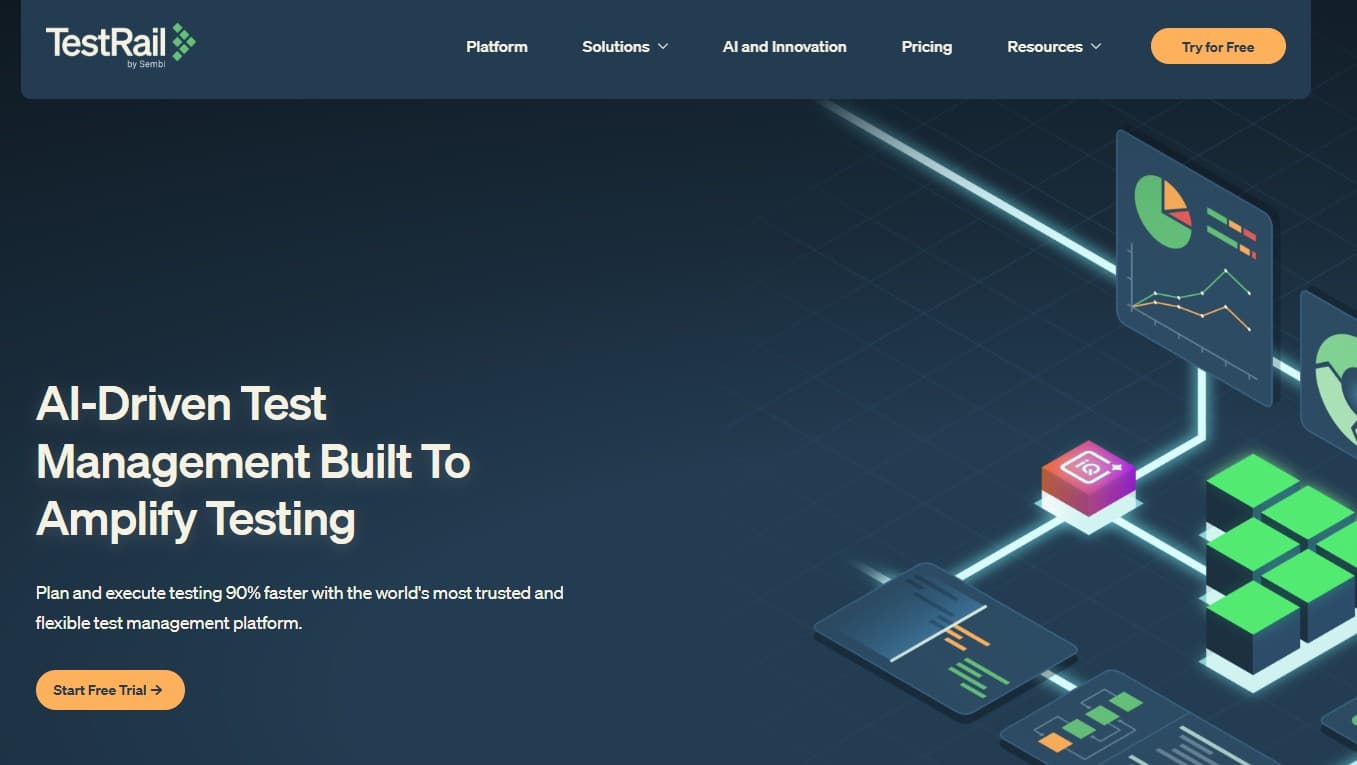
TestRail is a commercial, web-based test case management tool from Idera / Gurock, launched in 2010. It runs as TestRail Cloud or self-hosted Server/Enterprise. The model: test cases organized into suites and sections, runs that snapshot cases for a release, milestones grouping runs, and a reporting layer rolling everything up. Integrations cover Jira, Azure DevOps, GitHub, GitLab, Slack, and most CI systems via REST API and vendor plugins.
Side-by-side comparison
| Capability | TestLink | TestRail |
|---|---|---|
| License | GPL, free | Commercial, per-user per month |
| Deployment | Self-hosted (PHP + MySQL/Postgres) | Cloud SaaS or self-hosted Server/Enterprise |
| UX | Functional, dated | Modern, optimized for fast test execution |
| Test case model | Projects, plans, suites, cases, executions | Projects, suites, sections, cases, runs, milestones |
| API | SOAP / XML-RPC, partial REST | Modern REST API |
| CI integrations | ! community plugins, varying quality | ✓ Jenkins, CircleCI, GitHub Actions, GitLab CI |
| Issue tracker integrations | Jira, Mantis, Redmine, Bugzilla, Trac | Jira, Azure DevOps, GitHub, GitLab, Bitbucket |
| Reporting | Built-in but limited; SQL for anything custom | Dashboards, milestone reports, custom reports |
| Permissions | Role-based, project-scoped | Role-based, more granular |
| SSO / SAML | ! community plugins | ✓ Enterprise tier |
| Support | Community forums, GitHub issues | Vendor support (chat, email, SLA tiers) |
| Release cadence | Slow, community-driven | Steady, vendor-driven |
| Compliance / audit | ! you build it | ✓ Enterprise tier with audit logs and 21 CFR patterns |
| Total cost of ownership | Engineer time to host, upgrade, troubleshoot | Per-user fee, no infra burden if you use Cloud |
Where TestLink wins
License cost. TestLink is free. For a small QA team in a budget-constrained environment, that's the entire pitch and it can be enough.
Data sovereignty. The data lives on your servers, in your database, under your operations team's control. For organizations with strict data-residency rules or a no-cloud policy, that's a real benefit.
Open source flexibility. If you have PHP skills on staff, you can modify TestLink directly. Patch the UI, add a custom field type, extend the API. The same thing in TestRail requires either the vendor's roadmap or careful use of webhooks.
Small-team simplicity. For a five-person QA team running mostly manual tests with light integration needs, TestLink can be all you need.
Where TestRail wins
UX your team actually uses. TestRail's manual test runner, keyboard shortcuts, and bulk operations are designed for QA people who spend hours a day in the tool. TestLink's UI is functional but slow; click counts add up, and over months, that's a real productivity tax.
Modern REST API and CI ecosystem. Pushing automated results into TestRail from any major CI is a documented one-off. Doing the same with TestLink involves community plugins of varying quality, SOAP awkwardness, and more maintenance than the "free" license suggests.
Reporting without SQL. TestRail's reports answer most QA-lead questions (release readiness, defect density, automation coverage) out of the box. TestLink has reports but anything beyond the basics often means writing SQL or pulling data into a BI tool.
Vendor support and SLA. When something breaks at 11pm before a release, having a vendor to call is worth real money. With TestLink, the answer is community forums and your own ops team.
SSO, audit logs, compliance. TestRail Enterprise ships with SSO, audit logs, and patterns for regulated industries (pharma, medical devices, finance). TestLink can be made to fit those requirements but you're building it yourself.
Upgrades that don't hurt. Upgrading TestRail Cloud is something the vendor does. Upgrading self-hosted TestLink is a ritual: back up the DB, snapshot the VM, run the migration scripts, check the plugins, hope.
The total cost of ownership question
"Free" is misleading. The real cost of TestLink is the engineering time it consumes:
- Standing up the PHP/MySQL stack, securing it, monitoring it.
- Upgrading TestLink (and underlying PHP) every year.
- Backing up the database, testing the restore.
- Patching CVEs in PHP, MySQL, the underlying OS.
- Writing or maintaining community CI plugins.
- Answering "why is TestLink slow today" questions from QA.
For a small team this is maybe a few hours per month. For a larger team it's a fractional ops headcount. Run the numbers honestly. A TestRail Cloud subscription for 25 testers is often cheaper than the infrastructure and engineering time to keep TestLink healthy.
That said, if you already host PHP/MySQL apps and have the operational muscle, the marginal cost of one more app is low and the math can flip the other way.
Pricing reality in 2026
TestLink. $0 license. Hosting, backups, security, and engineering time are yours to pay for. Plan on at least a few hundred dollars per month in infrastructure plus whatever portion of an ops engineer maintains it.
TestRail Cloud Professional starts around $37 per user per month with annual billing. Enterprise (SSO, advanced compliance) is priced on request. Self-hosted Server licenses are annual per-user. Verify on the TestRail pricing page.
Integrations and automation
TestLink. Built-in Jira, Mantis, Redmine, Bugzilla, and Trac integration via configuration. SOAP / XML-RPC API for automation result imports. Community libraries for Jenkins and a handful of other CI systems. The integration story works but has rough edges; expect to invest engineering time.
TestRail. First-class Jira integration via the TestRail for Jira app. Native integrations or plugins for Azure DevOps, GitHub, GitLab, Bitbucket, Slack, Microsoft Teams. CI integrations for Jenkins, CircleCI, GitHub Actions, Azure Pipelines, GitLab CI. Open REST API with an active community library ecosystem in Python, Java, JavaScript, Ruby, and C#.
Migration considerations
Migrating from TestLink to TestRail is one of the more common test management migrations. TestRail's import tools handle TestLink XML exports for cases and structure, though you almost always have to rebuild custom fields, plans, and any CI glue from scratch. Budget two to six weeks depending on test estate size and how much automation has to be rewired.
Migrating the other direction (TestRail to TestLink) is rare and manual. Most teams don't do it.
If you're mid-evaluation, see our TestRail alternatives roundup for the broader landscape, and the test case management tools guide for an even wider view.
Where AI changes the picture
TestRail has shipped AI-assisted test case generation and natural- language search across the test estate. TestLink has no equivalent in the core project; you'd build it yourself against the OpenAI or Anthropic APIs, or pipe data into a separate AI tool.
The 2026 shift sits below test management. Scripted frameworks (Playwright, Cypress, Selenium) handle stable regression. Agentic tools handle the flows that change every sprint. Test management (TestRail or, with effort, TestLink) holds the cases, runs, and audit trail across both. See test management isn't dead and what agentic testing actually means.
qtrl posts results back to TestRail (and, with custom glue, TestLink) through their APIs, so the management and execution choices stay independent.
Decision checklist
Pick TestLink when:
- You have hard budget constraints and ops time is cheaper than license cost.
- Data residency or no-cloud policy makes self-hosting non-negotiable.
- Your QA team is small (5 to 15) and mostly runs manual tests.
- You have PHP/MySQL skills in-house and can own the upgrades.
- The integration surface you need is small and stable.
Pick TestRail when:
- You want a modern UI your QA team will use every day without complaint.
- CI and Jira integration depth matter.
- You don't want to spend engineering time on test management infrastructure.
- SSO, audit logs, and compliance patterns are required.
- You'd rather pay a vendor than pay an ops engineer.
Frequently asked questions
Is TestLink still maintained? Yes, though the cadence is slower than a commercial vendor's. Releases ship, bugs get fixed, and the project is actively on GitHub. The bigger risk is the smaller community and ecosystem around it.
Is TestRail's API really that much better? Yes. TestRail has a modern REST API with documented endpoints, official client libraries, and a stable ecosystem. TestLink's SOAP / XML-RPC API works but feels its age.
Can TestLink scale to hundreds of testers? Technically yes, in practice with friction. The UI doesn't feel built for scale, reporting becomes harder, and the operational cost climbs faster than the team size.
Which one is better for regulated industries? TestRail Enterprise, comfortably. The audit log and compliance story is built in. TestLink can be made to work, but you build the audit trail yourself.
What about Xray, Zephyr, qTest? See TestRail vs Xray, TestRail vs Zephyr, and TestRail vs qTest for those comparisons.
Is there a hosted version of TestLink? A few small vendors and integrators offer hosted TestLink. None has anywhere near the operational track record of TestRail Cloud.
What others say about TestLink
Before you commit either way, here's what current TestLink users say about it in public reviews:
“The UI is outdated and the tool gets hard to use with multiple users over time, especially with large amounts of data.”
G2 reviewer · G2 reviews
“Database design slows down test loading and execution status saving. Not recommended past about 2,000 tests per project.”
G2 reviewer · G2 reviews
“Community forum and bug tracker are broken, GitHub PRs sit untouched, and there is no real communication from lead developers.”
SourceForge reviewer · SourceForge reviews
What others say about TestRail
TestRail isn't without complaints either. The same gripes keep showing up across public reviews:
“TestRail starts to feel slow and clunky once suites grow large or you run lots of configurations and concurrent users, and the UI still feels old-school compared to newer tools.”
G2 reviewer, Program Manager (Small-Business) · G2 reviews
“Support has been hard to reach for quick resolutions, billing and product logins are separate, and managing multiple projects is more painful than it should be.”
G2 reviewer, Computer Software (Small-Business) · G2 reviews
“It slows down with lots of test cases, runs, or users, and collaboration feels static next to modern tools because comments lack real-time team interaction.”
G2 reviewer, IT Manager (Mid-Market) · G2 reviews
The thing that matters more than the choice
Test management tools rarely fail because of the tool. They fail because no one owns the test cases, runs stop being reviewed, traceability is theatrical, or the CI integration was never finished. TestLink can run a serious QA program; so can TestRail. Pick the one your team will actually use, write down who owns which tests, and put the saved energy into the discipline.
Whichever test management tool you pick, you'll still want an execution layer for the flows that change every sprint. qtrl is one option for the agentic side. Try it and see how it fits next to TestRail or TestLink.
Have more questions about AI testing and QA? Check out our FAQ