
TestRail vs Zephyr: a 2026 buyer's comparison
By qtrl Team · Engineering
TestRail and Zephyr are the two test management tools most QA leads end up comparing alongside Xray. The short version: TestRail is a standalone web app that integrates with Jira, Zephyr is a family of products that live closer to (or inside) Jira. The longer version matters because "Zephyr" is actually three different products under one brand, and the right comparison depends on which one you mean. This guide walks through what each is, how they differ in practice, what the 2026 pricing looks like, and how to pick without painting yourself into a corner.
The 60-second answer
Pick Zephyr Scale if you live in Jira, want test management as a native Jira app, and prefer SmartBear's structured folders-and-cases model over Xray's everything-is-a-Jira-issue approach. Pick TestRail if your QA team needs a tool that doesn't require a Jira license per tester, works across multiple issue trackers, and has a dedicated UI purpose-built for fast manual test execution. Both are mature products with broad enterprise adoption. The right answer is mostly about how deep your Jira commitment is and how big your QA team is relative to engineering.
Which Zephyr are we talking about?
SmartBear sells three Zephyr products. They are not interchangeable, and confusion between them is a top reason teams end up unhappy with their choice.
- Zephyr Scale (formerly TM4J, Test Management for Jira). The flagship. Lives as a Jira Cloud app, Jira Data Center app, and a standalone Cloud option. Folders, test cases, cycles, plans, custom fields.
- Zephyr Squad (formerly Zephyr for Jira). The older, simpler Jira app. Test cases are Jira issues, organized into cycles. Lighter than Scale.
- Zephyr Enterprise. The standalone Zephyr product, formerly Zephyr Enterprise Edition. Self-hosted or SaaS, used by larger orgs that want a tool outside Jira entirely.
For this comparison the relevant one is almost always Zephyr Scale, since it's SmartBear's current recommended product and the one most teams actually evaluate against TestRail. We call out Squad and Enterprise where the distinction matters.
What TestRail is
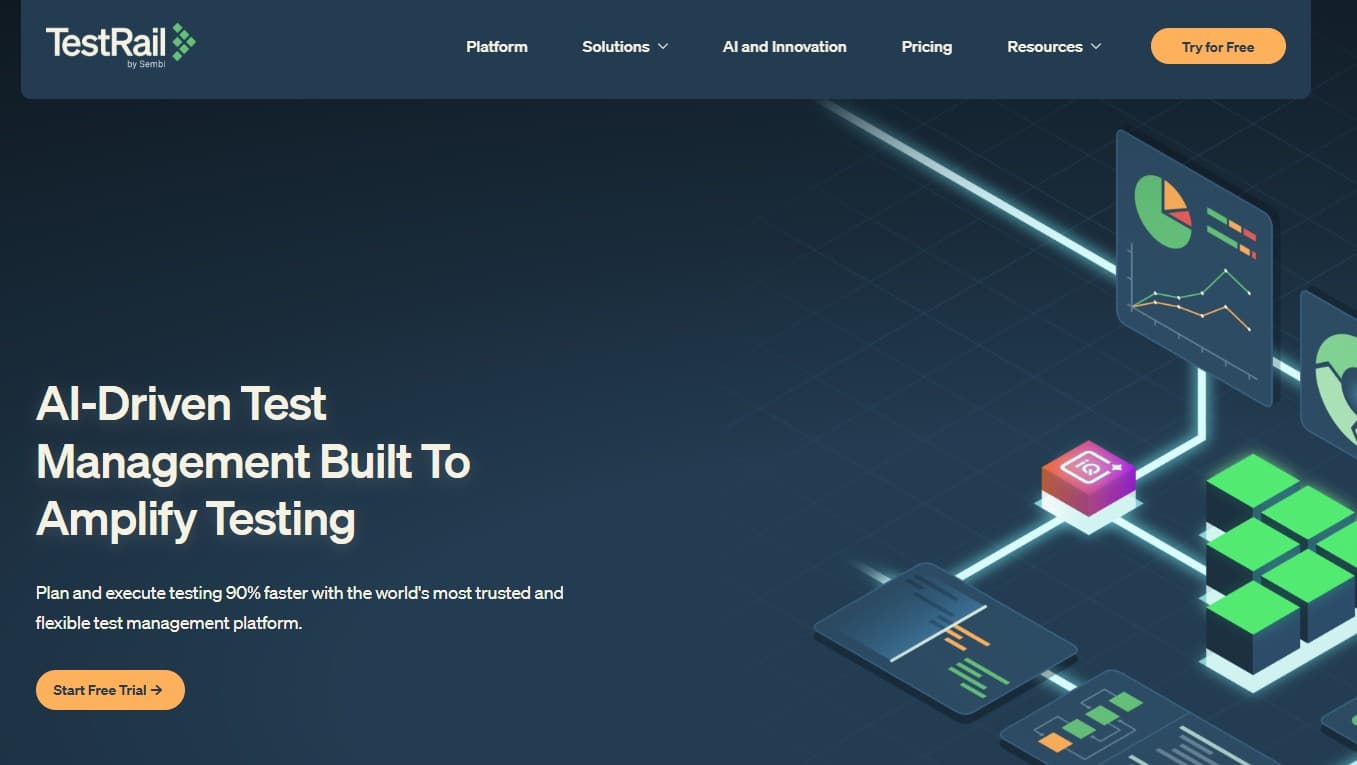
TestRail is a web-based test case management tool from Idera / Gurock. It launched in 2010 and is one of the most widely deployed QA tools in the industry. The model: test cases organized into suites and sections, test runs that snapshot those cases for a release, milestones grouping runs, and a reporting layer rolling everything up. TestRail integrates with Jira, Azure DevOps, GitHub, GitLab, and most CI systems via REST API and vendor plugins. It runs as TestRail Cloud or self-hosted Server/Enterprise.
What Zephyr Scale is
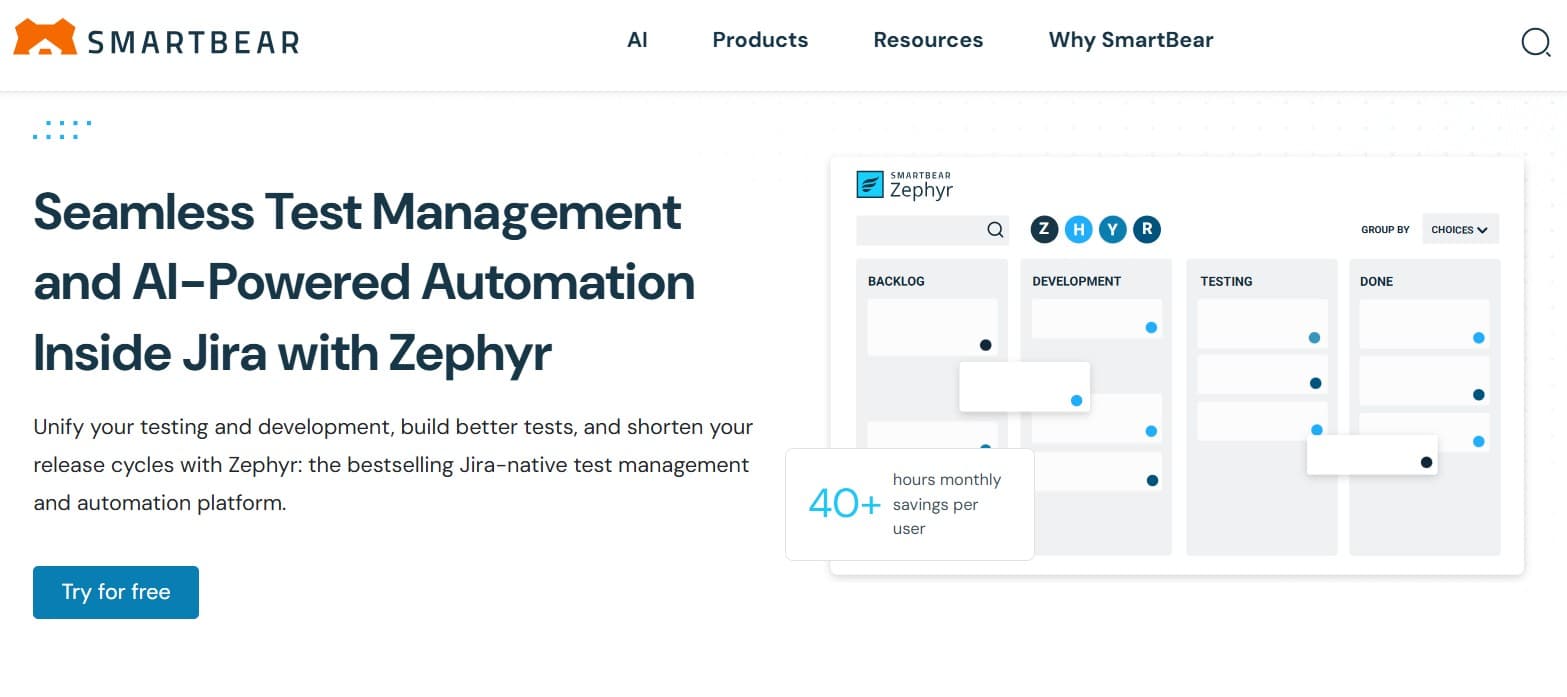
Zephyr Scale is SmartBear's Jira-native test management product. It organizes tests in a folder hierarchy (not as Jira issues, unlike Xray), with first-class test cycles, test plans, custom fields, and parameterized tests. It runs as a Jira Cloud app, a Jira Data Center app, and a Cloud standalone product for teams that want Zephyr without Jira.
The key architectural choice: tests in Zephyr Scale live in Scale's own data model, linked to Jira issues rather than being Jira issues themselves. That gives Scale better dedicated test management UX than Xray, while keeping the Jira proximity that Xray fans like.
Side-by-side comparison
| Capability | TestRail | Zephyr Scale |
|---|---|---|
| Deployment | Standalone web app (Cloud or self-hosted) | Jira app (Cloud, Data Center) or Scale Cloud standalone |
| Jira dependency | Optional integration | Required for Jira-hosted version |
| Test case model | Suites, sections, custom fields | Folders, cases, cycles, plans, custom fields |
| Reusable test runs | ✓ via Test Runs with snapshotting | ✓ via Test Cycles and Test Plans |
| BDD / Cucumber | ! via plugins / custom templates | ✓ native Gherkin scenario support |
| Parameterized tests | ! via custom fields and steps | ✓ native parameter sets |
| Cross-project traceability in Jira | ! external links | ✓ native Jira issue links |
| Non-Jira issue trackers | ✓ Azure DevOps, GitHub, GitLab | ! limited; primarily Jira |
| Automation integrations | REST API, Jenkins/CI plugins | REST API, JUnit/TestNG/Cucumber importers, native CI plugins |
| Reporting | Built-in dashboards, milestone reports, custom reports | Jira gadgets, Zephyr-specific dashboards, JQL |
| Self-hosted | ✓ TestRail Server / Enterprise | ✓ Zephyr Scale Data Center (Jira DC), Zephyr Enterprise |
| Pricing basis | Per TestRail user per month | Tiered per Jira user count (Cloud) or per-user (standalone) |
| Maturity | ~15 years | ~10 years (Scale, formerly TM4J) |
Where TestRail wins
QA teams larger than the Jira footprint. If you have manual testers, contractors, or outsourced testers who don't otherwise need Jira, TestRail charges only for the people who use TestRail. Zephyr Scale's Jira-hosted version assumes everyone is already in Jira.
Multi-tracker reality. If different parts of your org use Jira, Azure DevOps, and GitHub, TestRail bridges them. Zephyr Scale is happiest in a Jira-only world.
Compliance and audit. TestRail's self-hosted Enterprise edition has the longest track record in regulated environments (pharma, medical devices, finance, aerospace), with established 21 CFR Part 11 and GxP audit patterns. Zephyr Scale can meet the same bar but the implementation work tends to be heavier.
Dedicated manual test execution UI. TestRail's test runner is optimized for ripping through manual cases: keyboard shortcuts, bulk updates, fast pass/fail/blocked flows. Zephyr Scale is capable here but feels like a Jira surface, not a dedicated test runner.
Where Zephyr Scale wins
Deep Jira investment. If Jira is the system of record for everything in your company, Scale gets you native links, native JQL traceability, native permissions, native workflows.
Parameterized tests and BDD. Scale has first-class support for both. TestRail handles them through custom fields and templates, which works but is fiddlier.
Best-of-both inside Jira. Compared to Xray (which makes every test a Jira issue and inherits all the heaviness that brings), Scale's separate data model gives a snappier test management UX without leaving Jira. Many teams pick Scale specifically as a middle-ground between TestRail and Xray.
SmartBear ecosystem. If you're already using TestComplete, ReadyAPI, or Pactflow, the Zephyr Scale integration story is tighter.
Pricing reality in 2026
Verify on each vendor's website before signing anything. Both vendors discount at scale and pricing changes faster than blog posts do.
TestRail Cloud Professional starts around $37 per user per month with annual billing, Enterprise tiers (SSO, advanced compliance features) priced on request. Self-hosted Server licenses are sold annually per user.
Zephyr Scale Cloud uses Atlassian Marketplace tiered pricing based on total Jira users in the instance. At 10 users it's a few dollars per user per month. Tiers step up at 25, 50, 100, 250, and beyond. Scale Cloud (standalone) and Zephyr Enterprise are priced separately.
The practical comparison: small teams that already pay for Jira find Scale cheaper. Larger QA teams with testers who don't otherwise need Jira often find TestRail cheaper, because they aren't paying twice (Jira license plus Zephyr license) for each tester.
Integrations and automation
TestRail integrations. First-class Jira integration via the TestRail for Jira app (two-way sync of issues and defects). Native integrations or plugins for Azure DevOps, GitHub, GitLab, Bitbucket, Slack, Microsoft Teams. CI integrations for Jenkins, CircleCI, GitHub Actions, Azure Pipelines, GitLab CI. Open REST API with a deep community library ecosystem.
Zephyr Scale integrations. Native Jira everything. REST API for importing automated results from JUnit, TestNG, Cucumber, NUnit, xUnit, Robot Framework, and generic JSON. Native CI plugins for Jenkins, Bamboo, Azure DevOps, GitHub Actions, GitLab CI, Bitbucket Pipelines. SmartBear product integrations (TestComplete, ReadyAPI) are first-class.
Migration considerations
Migrating from TestRail to Zephyr Scale means mapping suites and sections to Scale's folder hierarchy, custom fields to Scale custom fields, and rewriting any automation glue that pushes results to TestRail. The reverse migration flattens Scale's folder model into TestRail suites and sections, and extracts test runs into TestRail's run model.
Both vendors publish migration documentation and have partner ecosystems that handle the move for enterprise customers. Budget for two to six weeks depending on test estate size, custom field complexity, and how much CI glue you have to rewrite.
If you're still mid-evaluation, see our TestRail alternatives roundup and the broader test case management tools guide.
Where AI changes the picture
Both vendors have shipped AI features in 2025 and 2026. TestRail's AI focuses on test case generation from requirements and natural-language search across the test estate. Zephyr Scale's AI helps generate test cases from Jira requirements and assists with test optimization. Both are useful, both are early, and neither one changes the deployment- model decision.
The bigger 2026 shift sits below test management. Scripted frameworks (Playwright, Cypress, Selenium) handle stable regression. Agentic tools handle the flows that change every sprint. Test management (TestRail or Zephyr Scale) holds the cases and runs across both. We made this argument in test management isn't dead.
qtrl is one option for the agentic execution layer, and posts results back to either TestRail or Zephyr Scale through their REST APIs, so the test management choice and the execution choice are independent.
Decision checklist
Pick TestRail when:
- You have testers who don't need Jira for anything else.
- You work across multiple issue trackers (Jira, Azure DevOps, GitHub).
- Manual test execution speed matters and you want a dedicated UI.
- Self-hosted, audit-ready storage is required for compliance reasons.
- Your QA team is larger than the slice of engineering using Jira.
Pick Zephyr Scale when:
- Everyone who touches QA already has a Jira license.
- You want test management inside Jira without the Xray heaviness.
- Native parameterized tests and Gherkin support are non-negotiable.
- Cross-project traceability via Jira links is more important than a dedicated QA UI.
- You're standardized on SmartBear and already use TestComplete or ReadyAPI.
Frequently asked questions
Is Zephyr Squad the same as Zephyr Scale? No. Squad is the older, simpler product where tests are Jira issues. Scale is the newer, recommended product with a separate data model. If you evaluated Zephyr years ago and saw Squad, look at Scale before deciding.
Can I use Zephyr Scale without Jira? Yes, via Zephyr Scale Cloud standalone. It's less popular than the Jira-hosted version but available.
Which has better automation framework support? Tie. Both ingest results from any major framework via REST APIs and CI plugins. Zephyr Scale has slightly tighter native Gherkin integration; TestRail has slightly broader community library coverage.
Which is better for regulated industries? TestRail historically. Self-hosted Enterprise has the longest 21 CFR Part 11 / GxP audit precedent. Zephyr Scale on Jira Data Center is auditable but requires more setup.
What about Xray? Xray is the third major option here. See TestRail vs Xray for that comparison.
Does either one run automated tests? No. Both ingest results from CI through REST APIs. The execution happens in your framework or AI tool, the management happens in TestRail or Zephyr. For the tools that run the tests themselves, see best agentic testing tools.
What others say about TestRail
The same complaints about TestRail keep showing up across G2 reviews:
“Support has been hard to reach for quick resolutions, billing and product logins are separate, and managing multiple projects is more painful than it should be.”
G2 reviewer, Computer Software (Small-Business) · G2 reviews
“It slows down with lots of test cases, runs, or users, and collaboration feels static next to modern tools because comments lack real-time team interaction.”
G2 reviewer, IT Manager (Mid-Market) · G2 reviews
What others say about Zephyr Scale
Zephyr reviewers point to a recurring set of issues around UI, reporting, and support:
“The UI is initially confusing, integrations sometimes need better syncing, large test cases can be slow, pricing feels high for smaller teams, and support can be delayed.”
G2 reviewer, Manual Tester (Enterprise) · G2 reviews
“Reliable overall, but reporting and performance are areas needing improvement, and large repositories can feel slow.”
Gartner reviewer, Engineering Manager in IT Services (500M–1B USD) · Gartner Peer Insights
“Customer support has felt overwhelmed and slow. Open tickets have aged four months or more without resolution.”
Gartner reviewer, Manager of IT Services in Telecommunications (10B+ USD) · Gartner Peer Insights
The thing that matters more than the choice
Test management tools rarely fail because of the tool. They fail because no one owns the test cases, runs stop being reviewed, traceability is theatrical, or the CI integration was never finished. TestRail and Zephyr Scale are both capable enough to run a serious QA program. Pick the one that fits your Jira reality and your team shape, write down who owns which tests, and spend the saved energy on the discipline.
Whichever test management tool you pick, you'll still want an execution layer for the parts of your app that change every sprint. qtrl is one option for the agentic side. Try it and see how it fits next to TestRail or Zephyr Scale.
Have more questions about AI testing and QA? Check out our FAQ