
TestRail vs qTest: a 2026 enterprise QA comparison
By qtrl Team · Engineering
TestRail and qTest are the two test management tools enterprise QA leads most often compare when the spreadsheet stops scaling and a Jira app isn't enough. They sit in similar territory: standalone web apps that integrate with Jira and most CI systems, both with self-hosted options, both used heavily in regulated industries. The interesting differences show up in pricing model, automation depth, reporting, and which size of org each one fits naturally. This guide walks through what each is, where each one wins, the 2026 pricing reality, and how to pick without backing into a multi-year commitment you regret.
The 60-second answer
Pick qTest if you're a mid-to-large enterprise that needs a unified platform (manual, exploratory, automation orchestration, BDD) under one roof and you've outgrown TestRail's lighter feature set. Pick TestRail if you want a simpler, cleaner test management tool that QA leads actually like using, a less heavy procurement process, and pricing that doesn't require a sales call to understand. Both are capable enterprise tools. qTest is built for the org that wants one big Tricentis-aligned platform; TestRail is built for the QA team that wants a sharp test management tool and to keep automation in its own stack.
What TestRail is
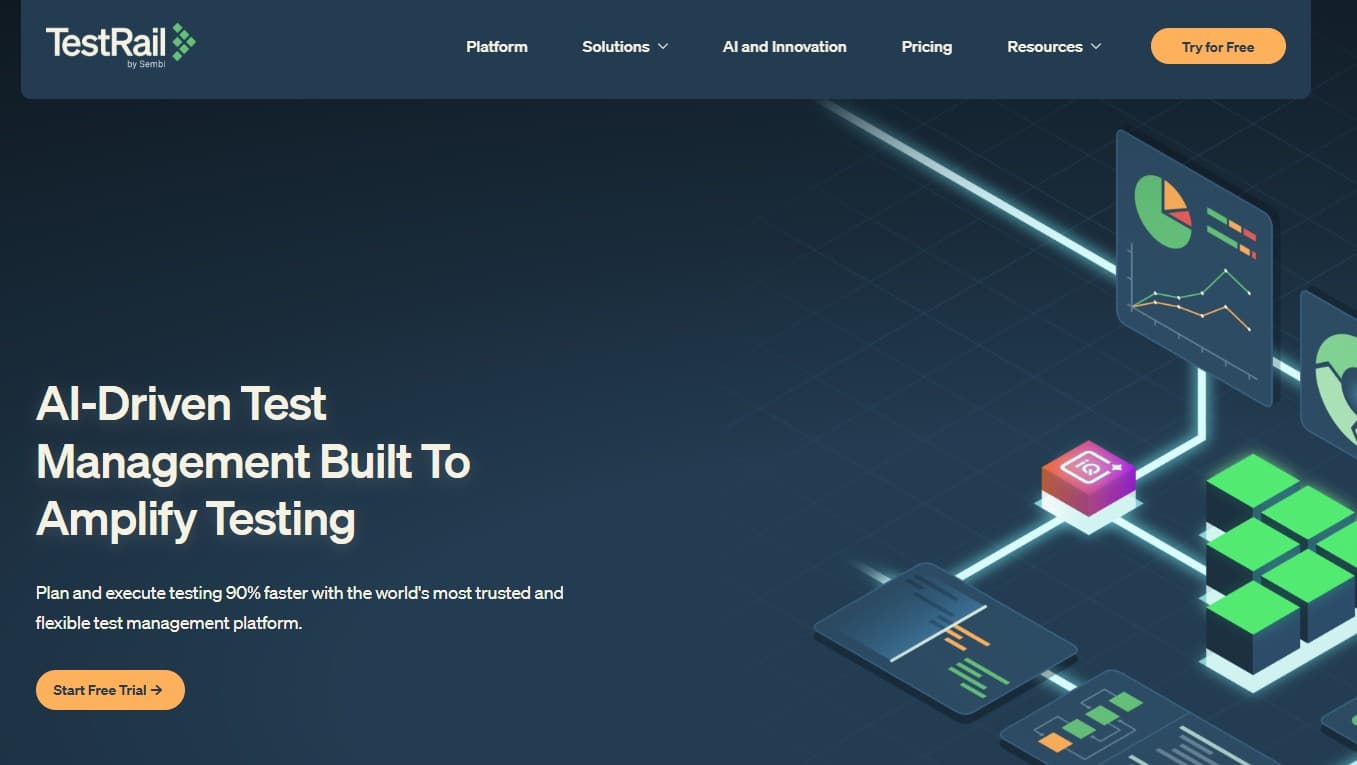
TestRail is a web-based test case management tool from Idera / Gurock, launched in 2010. It models tests as cases organized into suites and sections, runs that snapshot those cases for a release, milestones grouping runs, and a reporting layer rolling everything up. TestRail integrates with Jira, Azure DevOps, GitHub, GitLab, and most CI systems via REST API and vendor plugins. Available as TestRail Cloud or self-hosted Server/Enterprise.
What qTest is
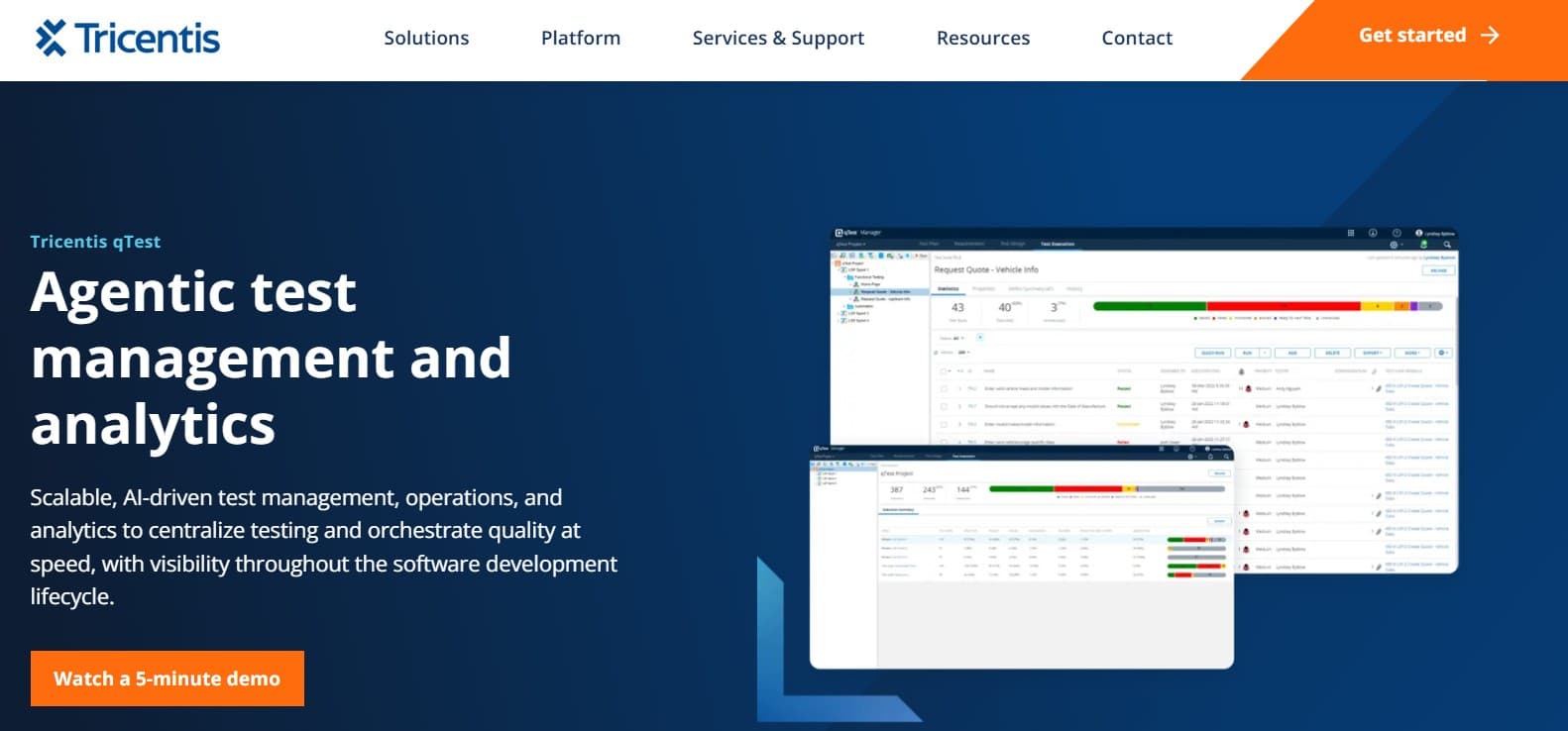
qTest is Tricentis' enterprise test management platform, originally built by QASymphony and acquired by Tricentis in 2018. It's a family of modules: qTest Manager (test case management and execution), qTest Launch (CI / automation orchestration), qTest Explorer (exploratory testing capture), qTest Pulse (analytics), qTest Scenario (BDD). The full platform is one of the deepest enterprise test management offerings on the market.
It runs as a Cloud SaaS product or self-hosted (qTest On-Premises). The target customer is the large enterprise with hundreds or thousands of QA users, complex automation portfolios, and a board-level mandate to consolidate test tooling onto one platform, often as part of a broader Tricentis (Tosca) commitment.
Side-by-side comparison
| Capability | TestRail | qTest |
|---|---|---|
| Vendor | Idera / Gurock | Tricentis |
| Product shape | Single product, focused on test management | Module family (Manager, Launch, Explorer, Pulse, Scenario) |
| Test case model | Suites, sections, custom fields | Modules, requirements, test cases, test cycles |
| Manual test execution | ✓ purpose-built fast runner | ✓ structured test execution with step-level evidence |
| Exploratory testing | ! basic notes / sessions | ✓ qTest Explorer with screen capture and timeline |
| Automation orchestration | ! via REST API and CI plugins | ✓ qTest Launch as a native automation hub |
| BDD / Cucumber | ! via plugins and custom templates | ✓ qTest Scenario module |
| Analytics and reporting | Built-in dashboards, milestone reports | qTest Pulse for cross-project analytics, OData feeds |
| Issue tracker integrations | Jira, Azure DevOps, GitHub, GitLab, Bitbucket | Jira, Azure DevOps, GitHub, Rally, VersionOne |
| Self-hosted | ✓ TestRail Server / Enterprise | ✓ qTest On-Premises |
| Pricing model | Per-user per month, listed publicly | Quote-based, module-based, annual |
| Target customer | QA teams 10 to 500+ | Large enterprise QA, often 200 to 5,000+ |
| Tosca / Tricentis alignment | ! external integration | ✓ native (same vendor) |
| Setup and time-to-value | Days | Weeks to months |
Where TestRail wins
Time to value. TestRail is something a QA lead can buy, configure, and have the team using in a week. qTest implementations, especially across the full module suite, are real projects that involve Tricentis Professional Services or a partner.
Pricing transparency. TestRail publishes per-user pricing on its website. qTest is quote-based. For teams that need to budget without a sales cycle, that's a meaningful difference.
UX teams actually like. TestRail's test runner is designed for QA people to use every day. It feels light and quick. qTest's UI is more powerful but heavier; QA users routinely describe it as feature-rich but slower to navigate.
Right-sizing. Mid-sized QA orgs (20 to 200 users) often find TestRail's feature set is exactly what they need. qTest can feel oversized for that range; you pay for modules you don't use.
Better fit when you keep automation separate. If your automation lives in Playwright, Selenium, or an AI execution tool and you just want test management to track it, TestRail is the simpler match. qTest Launch starts to earn its slot when automation orchestration is itself a hard problem you want to centralize.
Where qTest wins
One platform across the QA lifecycle. Manager, Launch, Explorer, Pulse, Scenario covers test management, automation orchestration, exploratory capture, analytics, and BDD inside a single vendor and data model. Large enterprises consolidating tooling get leverage out of that.
Tricentis alignment. If you're already running Tosca, qTest is the obvious choice. The integration is native and the commercial conversation is one negotiation, not two.
Exploratory testing depth. qTest Explorer's session capture (screens, actions, timeline) is the strongest out-of-the-box exploratory testing capability in the major test management vendors. TestRail has session notes but nothing comparable.
Cross-project analytics. qTest Pulse aggregates data across projects and exposes it through OData feeds for Power BI / Tableau. TestRail's reporting is solid within a project but doesn't roll up across the portfolio as cleanly.
Automation orchestration as a first-class concern. If you have hundreds of automation suites running across multiple frameworks and CI systems, qTest Launch gives you one place to schedule, monitor, and analyze them. TestRail expects you to handle that in your CI.
Pricing reality in 2026
Verify on each vendor before committing. Both discount at scale and the list prices below are starting points, not landing prices.
TestRail Cloud Professional starts around $37 per user per month with annual billing. Enterprise tier (SSO, advanced compliance, priority support) is priced on request. Self-hosted Server licenses are annual per-user.
qTest is quote-only. Pricing scales with module selection (Manager is the base; Launch, Explorer, Pulse, Scenario are add-ons) and user count. Public references and review sites suggest per-user costs in the $40 to $80 range depending on modules and volume, but the only reliable number is the one Tricentis gives you. Expect a sales cycle.
The honest comparison: at small and mid sizes TestRail typically lands cheaper, especially because you're only paying for one product. At large sizes with the full module suite, qTest can be cost-competitive or cheaper per "tool replaced" basis, since you're retiring multiple line items.
Integrations and automation
TestRail. First-class Jira integration via the TestRail for Jira app. Native integrations for Azure DevOps, GitHub, GitLab, Bitbucket, Slack, Microsoft Teams. CI integrations for Jenkins, CircleCI, GitHub Actions, Azure Pipelines, GitLab CI. Open REST API with a deep community library ecosystem (Python, Java, JavaScript, Ruby, C#).
qTest. Jira and Azure DevOps integrations are first-class with two-way sync. Native integration with Tricentis Tosca. qTest Launch acts as an automation hub for Selenium, Appium, JUnit, TestNG, Cucumber, Robot Framework, UFT, Tosca, and more. REST API and OData feeds for custom analytics. Smaller community library ecosystem than TestRail because the platform is more enterprise-direct.
Compliance and audit
Both tools have a presence in regulated industries. TestRail Enterprise is widely deployed in pharma, medical devices, finance, and aerospace with established patterns for 21 CFR Part 11, GxP, IEC 62304, and related standards. qTest is similarly capable, with explicit life sciences and regulated-industry features.
For a smaller, focused QA team in a regulated environment, TestRail tends to be the lower-friction choice. For a large enterprise that needs analytics and exploratory evidence capture rolled into the audit story, qTest's broader module set adds up.
Migration considerations
Migrating from one to the other is a real project. TestRail to qTest means mapping suites/sections to qTest modules and test cycles, custom fields to custom fields, and rebuilding the CI integration glue (and often the dashboards). qTest to TestRail is the same in reverse: flattening modules into suites and sections, simplifying custom fields, and rebuilding reports.
Both vendors and their partners run migration projects. Budget two to eight weeks depending on test estate size, custom field complexity, and how much automation/CI glue has to be rewritten.
For broader market context see our qTest alternatives roundup and TestRail alternatives roundup.
Where AI changes the picture
Both vendors are shipping AI features in 2025 and 2026. TestRail's AI focuses on test case generation from requirements and natural-language search. qTest has AI features for test case generation, defect triage, and Pulse-driven analytics. Both are useful, both are early, neither one rewrites the deployment decision.
The deeper 2026 shift sits below test management. Scripted frameworks (Playwright, Cypress, Selenium) handle stable regression. Agentic tools handle flows that change every sprint. Test management (TestRail or qTest) holds the cases, the runs, and the audit trail across both. We covered the stack in test management isn't dead and what agentic testing actually means.
qtrl posts results back to either TestRail or qTest through their REST APIs, so the test management and execution choices are independent.
Decision checklist
Pick TestRail when:
- You want test management, not a platform consolidation project.
- Pricing transparency and a short sales cycle matter.
- QA team size is 10 to 200 and you're happy keeping automation, exploratory, and analytics in their own stacks.
- You aren't already standardized on Tricentis Tosca.
- Time to value in weeks (not quarters) matters.
Pick qTest when:
- You're a large enterprise consolidating multiple QA tools onto one vendor.
- You already run Tricentis Tosca or are evaluating it.
- Automation orchestration is a hard, centralized problem worth a dedicated module.
- Exploratory testing with session evidence capture is required.
- Cross-project analytics through OData / Pulse drives executive reporting.
Frequently asked questions
Is qTest the same as Tosca? No. qTest is the test management platform; Tosca is the automation platform. Both are Tricentis products and integrate natively, but they solve different problems.
Does TestRail have a Jira app? Yes, the TestRail for Jira app provides two-way sync of issues and defects. It's not Jira-native the way Xray or Zephyr Scale is; it's a connected tool.
Which one is better for AI testing? Tie at the management layer. Both are working on AI-assisted test generation. The more interesting AI question is about execution, not management; see what agentic testing actually means and the tools that do it.
Can we use both? Technically yes, but it's rare and almost always a transition state during a migration. Don't plan on running both as the steady state.
Which one is better for regulated industries? Both have track records in pharma, medical devices, and finance. TestRail is the lighter implementation. qTest covers more of the audit story in one product if you use the full module suite.
What about Xray and Zephyr? See TestRail vs Xray and TestRail vs Zephyr for those comparisons.
What others say about TestRail
Public reviews of TestRail keep surfacing the same gripes:
“TestRail starts to feel slow and clunky once suites grow large or you run lots of configurations and concurrent users, and the UI still feels old-school compared to newer tools.”
G2 reviewer, Program Manager (Small-Business) · G2 reviews
“Support has been hard to reach for quick resolutions, billing and product logins are separate, and managing multiple projects is more painful than it should be.”
G2 reviewer, Computer Software (Small-Business) · G2 reviews
What others say about qTest
qTest gets steady marks on the basics, but reviewers consistently call out the same gaps:
“The Azure Pipelines integration does not fully update test status, which limits how much you can trust the automated results.”
G2 reviewer, IT and Services (Mid-Market) · G2 reviews
“Advanced metrics and reporting feel clunky and workflow customization is limited.”
G2 reviewer, Functional Tester (Mid-Market) · G2 reviews
“qTest handles mainstream test management but lacks newer AI-era capabilities such as self-healing tests, and AI-generated cases still need substantial manual cleanup.”
Gartner reviewer, Software Developer in IT Services (1B–10B USD) · Gartner Peer Insights
The thing that matters more than the choice
Test management tools rarely fail because of the tool. They fail because the ownership model is unclear, runs stop being reviewed, traceability is theatrical, or the CI integration was never finished. TestRail and qTest are both capable enough to run a serious enterprise QA program. Pick the one whose scope matches your org's scope, write down who owns which tests, and put the saved energy into discipline.
Whichever test management tool you pick, you'll still want an execution layer for the flows that change every sprint. qtrl is one option for the agentic side. Try it and see how it fits next to TestRail or qTest.
Have more questions about AI testing and QA? Check out our FAQ